How To Build A Bullet-Proof Content Approval Process
52% of companies miss deadlines because of approval delays. Here is how to build a content approval process that actually works at scale.
You know the feeling. A piece of content is finished, but instead of going live, it gets lost in someone’s inbox or an endless Slack thread. It comes back days later with notes from four people, two of whom were never supposed to be involved, and your publish date slips.
This is not a one-off. The average approval process takes eight days from submission to sign-off. As Jen Neary, Director of Content at Canto, puts it:
"The content bottleneck has shifted from production to operations. You can produce content faster with AI, but if your team can't find the right asset, doesn't know which version is current, or has to manually push updates across channels, you're just creating more chaos."
A slow approval process is a structural problem, and the fix is a clear, repeatable system that tells everyone exactly where a piece of content is, who owns it, and what happens before it moves forward. This guide walks you through building that system.
What Is A Content Approval Process?
A content approval process is the structured sequence of review, feedback, and sign-off steps that content moves through before it’s published. Each stage has a purpose, an owner, and a clear output before anything progresses.
⚠️ Note: Reviews and approvals are not the same thing. A review evaluates content and provides feedback. The approval gives formal sign-off to publish the content. Reviewers improve content; approvers accept accountability for it going live.
A 2025 Canto report found that only 43% of teams describe their workflows as standardized and automated. When approvals happen over email and Slack, there’s no accountability, no visibility, and no audit trail.
As content production and team size grow, those gaps become the reason your content calendar is perpetually behind.
Key Roles In A Content Approval Process
Every approval workflow involves a core set of stakeholders. The titles vary, but the roles are consistent:
Role ambiguity is the most common failure point in approval workflows. When everyone can technically approve something, nothing gets approved on time. The framework that solves this is the RACI model, which stands for Responsible, Accountable, Consulted, and Informed.
Applied to content workflows, it works like this:
- Responsible (R): Does the work.
- Accountable (A): Owns the outcome and gives final sign-off (there should be only one Accountable person per task)
- Consulted (C): Provides input before work advances.
- Informed (I): Receives updates but does not contribute directly (and cannot hold up the process).
Here is what that looks like applied to a standard blog post:
The payoff is measurable: teams that implement clear role frameworks see a 35% reduction in approval delays.
How To Build A Content Approval Process In 5 Steps
Step 1: Audit your current workflow
Before building something new, map what is actually happening today. Who touches content, in what order, and through what channels?
If approvals are happening in Slack and email threads, write that down. If there’s no process at all and it’s just whoever responds first, jot that down too.
This audit will surface bottlenecks. Maybe content sits for four days waiting on one person. Maybe feedback comes from three people at the same time with no clear priority. As Joni Blecher, Content Manager at Smartsheet, puts it:
"One thing that doesn't work is too much process — too many hoops to jump through before a piece of content can get to its final destination."
Step 2: Define content types and match each to a workflow
A social media post and a 5,000-word white paper won’t have the same approval process. Assign each content type to a tier:
Use the RACI model to define ownership at each stage, then apply a firm rule: no more than one or two approvers per stage. Every additional approver slows the process.
Elaine Chen, Founder of marketing consultancy Excogita, has seen this firsthand:
"Having one person responsible for approving everything is common unfortunately — especially in smaller organizations — but is a disaster. Suppose that person is super busy, goes on vacation, or is out sick. Then everything comes to a standstill."
At Nectafy, that single point of accountability is intentional rather than accidental. Asked how the agency maintains brand voice across multiple writers and clients, founder Lance Cummins says: "The guardian of the brand is our editor, so essentially it's her responsibility." Writers still carry their share of the load, though. "The writers are responsible as well, obviously, but the editors, like the goalie, can't let things through." The distinction matters: writers own quality at the draft stage, so the editor isn't approving everything from scratch, just holding the final line.
Step 4: Set review criteria and deadlines
Give reviewers two things: a standard to evaluate against, and a deadline to work within.
The standard is a set of guidelines covering brand voice, formatting, factual accuracy, CTA alignment, and whatever else matters for each content type. If you don’t have content guidelines yet, I would strongly suggest creating one ASAP, especially if you have multiple writers you’re working with.
Guidelines tell writers how to format content, what tone of voice to use, how to deliver content (e.g., in a Google Doc or Microsoft Word document), and more. Without it, writing style will drift from piece to piece, and reviewers don’t know how or what to evaluate content against. Feedback then becomes subjective and inconsistent, leading to revision loops that never resolve.
With guidelines out of the way, set a deadline for each stage in the content creation process. Based on industry benchmarks, these targets work for most teams:
- Initial editorial review: 24 hours
- Subject matter expert review: 48 hours
- Legal or compliance review: 24 to 48 hours
- Final sign-off: 24 hours
💡The process works: One brand cut its campaign approval time from 14 days to 4 days simply by implementing and enforcing formal deadlines.
Step 5: Centralize your content process in one tool
Get everything out of email or Slack and into a single, shared, trackable workspace. A centralized tool gives your team one source of truth: current draft, current status, current feedback, current owner.
When evaluating tools, look for role-based access controls, status tracking, and a robust audit trail.
I use Trello for this. Here’s what my setup looks like:
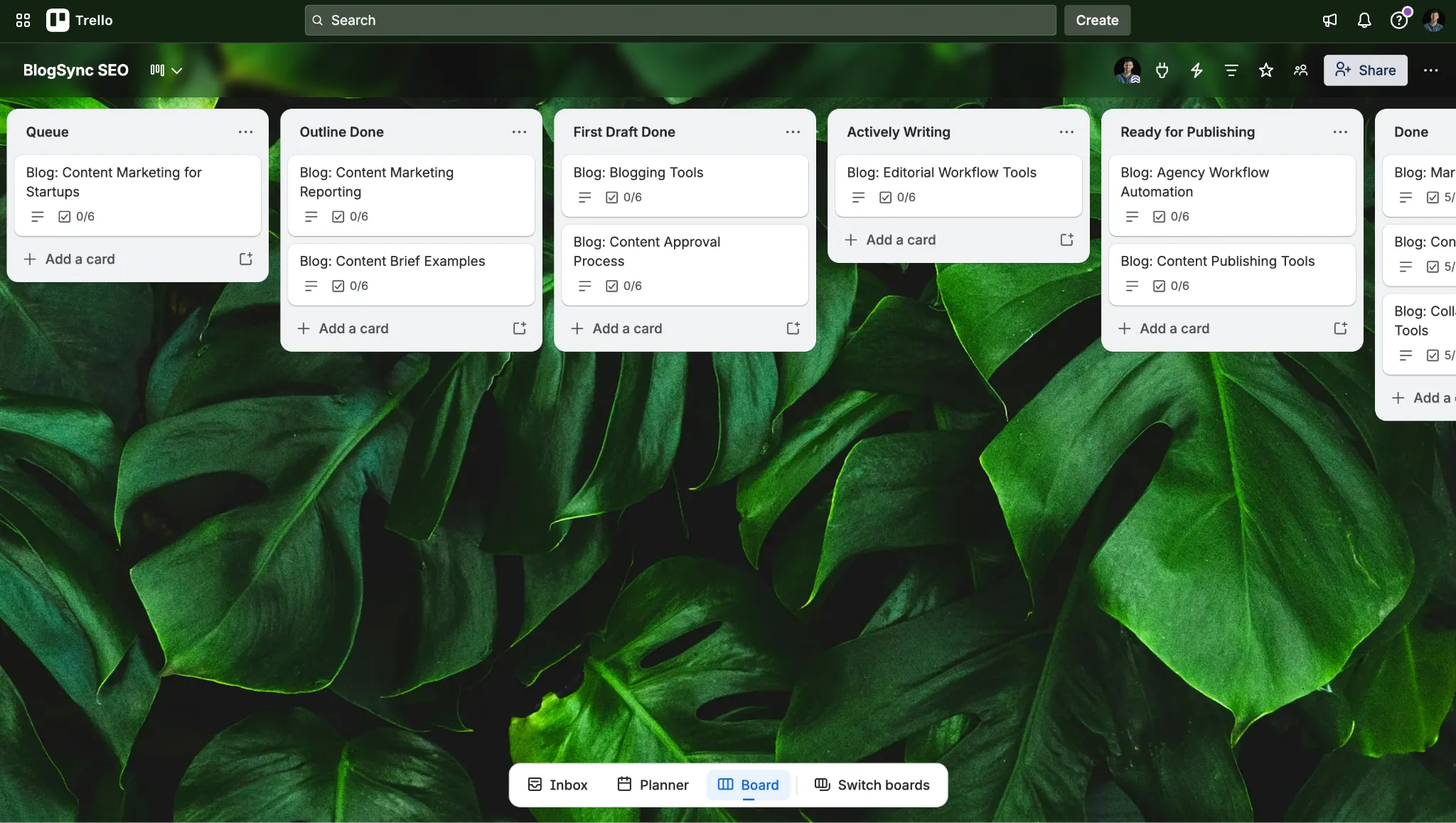
I have a dedicated Kanban board for our editorial workflow, with lists for Queue, Outline Done, First Draft Done, Actively Writing, Ready for Publishing, and Done. The beauty of Trello is that you can create as many lists as you need and name them whatever makes sense for your team. This is just what works for me.
Each card is an article. Within each card, I include a link to the article draft (in Google Docs) and have checklists for publishing tasks like setting metadata details when posts go live:
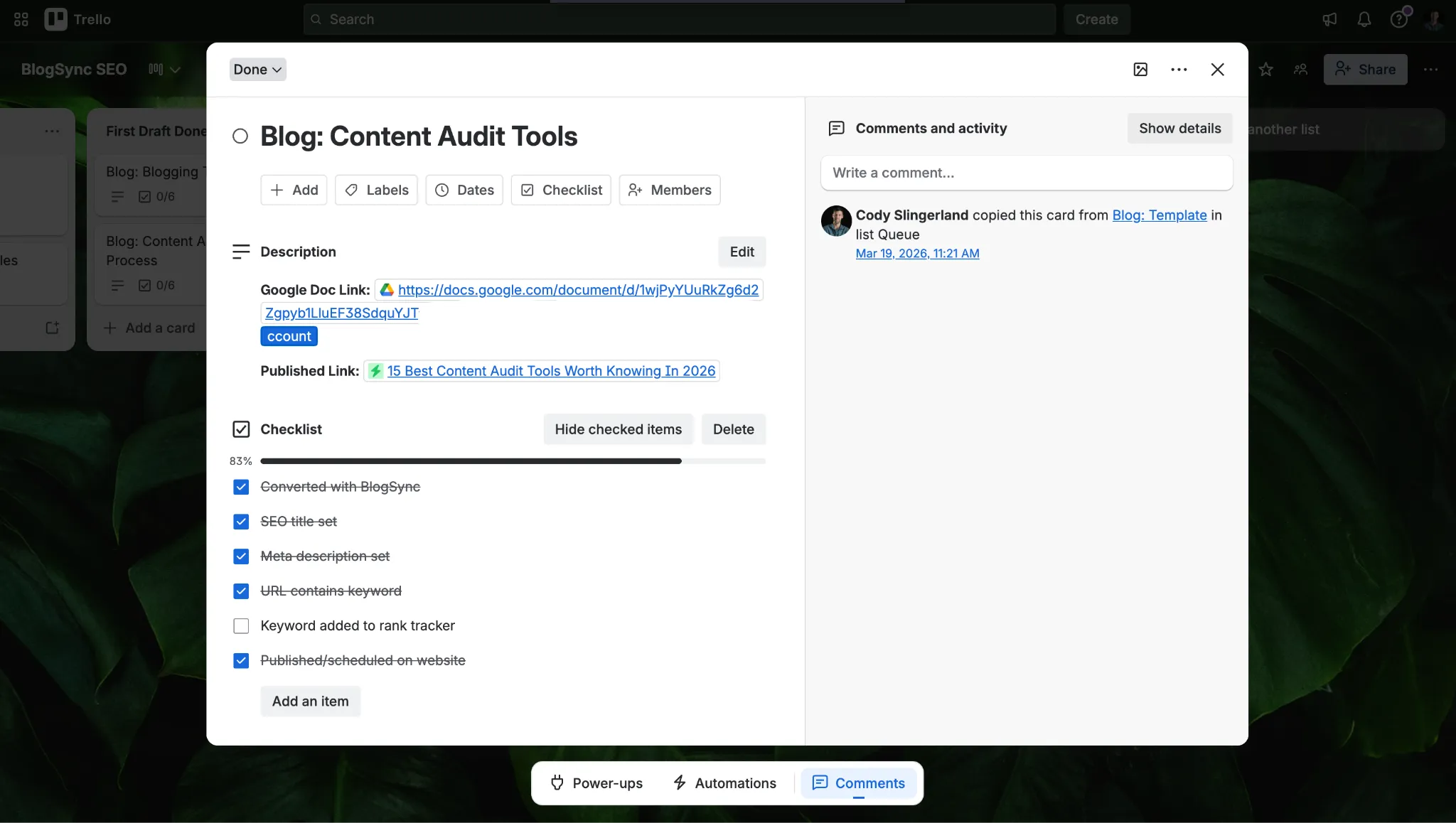
I can then put status update (like tagging clients when content is ready for review) in the card comments. Any suggestions or comments on the writing itself go in the Google Doc.
I put together an entire guide on the best editorial workflows here if you want a deeper dive on the available options today.
That setup works well for internal reviewers, but if your approvals involve external clients, a shared board alone may not cut it. Nectafy built what founder Lance Cummins calls a "deliverables board," where clients get "a dedicated web page with all their assets to edit or approve." Nothing moves to publishing until "they hit approve" on that page, keeping sign-off explicit and out of email threads entirely.
Common Bottlenecks & How To Fix Them
Even with a documented process, you will hit walls. Here are the most common mistakes teams face, and how you can fix them.
Too many approvers
Five people with approval authority means five potential vetos, not higher quality.
If the person is not accountable for content going out wrong, they should be in the Consulted or Informed column. A Ziflow survey found that 42% of marketing leaders experienced delays because stakeholders failed to provide feedback on time.
More approvers compounds this problem.
Vague or unconstructive feedback
"This doesn't feel right" is not actionable. Provide a structured feedback template: identify the specific issue, explain why it is a problem, and suggest an edit or new direction.
If a reviewer consistently gives unusable feedback, that is a process issue you need to address ASAP. If they can’t give clear and actionable feedback, they should not be part of the review process.
Version control chaos
When a draft lives in email, Slack, Google Docs, and someone's desktop all at the same, conflicting edits will inevitably get merged into a "final" version.
The fix is easy: choose one system and stick with it. For most teams, it will be Google Docs for writing and a project management tool (like Trello or ClickUp) to manage the editorial workflow.
Suggestions, edits, and comments on the content itself should go in the Google Doc (not Slack or email). Only status updates should go on cards in Trello or whatever editorial workflow tool you choose.
Approval fatigue
When your reviewers are overwhelmed, approvals will stall. A 2025 Canto report found 44% of employees report burnout tied to poor content workflow management. That fatigue is a signal your approval chain is too broad.
Reduce what any single approver is responsible for and audit whether everything truly needs their sign-off.
Stalled approvals past SLA
Build an automated escalation path: if a review is not completed within the deadline window, an automatic alert should go out to the content manager.
Unresolved 24 hours later, it escalates to the next decision-maker. This should be agreed upon before it is ever needed.
Wrapping Up
52% of companies miss deadlines because of approval delays. A well-built content approval process does remove this burden.
Start with an audit, apply RACI to assign clear ownership, set clear deadlines for each stage, and get everything out of email and into one central platform (like Trello, Asana, ClickUp, etc).
The goal is not a perfect process on paper. It is a consistent one in practice, that allow your team to do what they do best: creat great content worth publishing.
That said, the content process does not end there. Teams lose a surprising amount of time publishing content once it’s approved (generally around 20-30 minutes per blog post). That’s where BlogSync comes in.
BlogSync handles that final step by publishing directly from Google Docs, Word, or Notion to your CMS, whether that’s WordPress, HubSpot, Webflow, Ghost, Contentful, Sanity, or something else. BlogSync retains your content formatting, generates clean HTML, automatically optimizes images and names them, and stages directly to your website, turning a 20-30 minute process into just a few minutes.
For teams publishing at any kind of volume, removing that manual handoff is one of the easiest ways to save time without cutting corners on quality. Try it for free here.
Frequently Asked Questions
What is the difference between content review and content approval?
A content review is the process of evaluating content against quality, accuracy, and brand standards, and then providing feedback for improvement. A content approval is the formal sign-off authorizing the content to be published. Reviewers improve content; approvers authorize it to go live.
How many approvers should a content workflow have?
One final approver per content type is best. Adding more creates conflicting feedback, dilutes accountability, and slows the process. Use RACI to separate approvers (who own sign-off) from consultants (who provide input but cannot block progress).
How long should a content approval process take?
For most marketing copy, three to five business days end-to-end is a reasonable target. Initial editorial review should take 24 hours, SME or compliance review 48 hours, and final approval within 24 hours.
What tools are used for content approval workflows?
Common options include dedicated platforms like Trello, Asana, ClickUp, Monday.com, Airtable, Notion, and CoSchedule
What is a content approval workflow template?
A pre-built, repeatable structure mapping the stages, roles, and deadlines for a specific content type. A basic blog post template looks like: Draft complete (writer) → Editorial review (editor, 24-hour SLA) → SME review if needed (48-hour SLA) → Final approval (content manager, 24-hour SLA) → Publish.