Contentful or Sanity? The answer hinges on your team's structure, budget, and how much CMS customization you're actually willing to do.
If you're building a modern web project and you've narrowed your CMS shortlist to Contentful and Sanity, you're in good company. Both are API-first, headless content management platforms. Both power some of the biggest digital experiences on the web. And both are genuinely excellent at what they do.
However, Contentful and Sanity think about content management in fundamentally different ways, and picking the wrong one means fighting your CMS for years. The numbers back this up: Sanity has a 4.7/5 rating on G2 across 914 reviews, while Contentful has a 4.2/5 rating across 322 reviews, and the gap isn't random. It reflects a real difference in who each platform is built for.
This guide is for developers, content leads, and marketing teams deciding which platform to use. We'll break down content modeling, developer experience, pricing (with actual numbers), and real-world use cases so you can make a confident decision.
This is where the two platforms diverge most sharply, and where getting clarity early saves the most pain downstream.
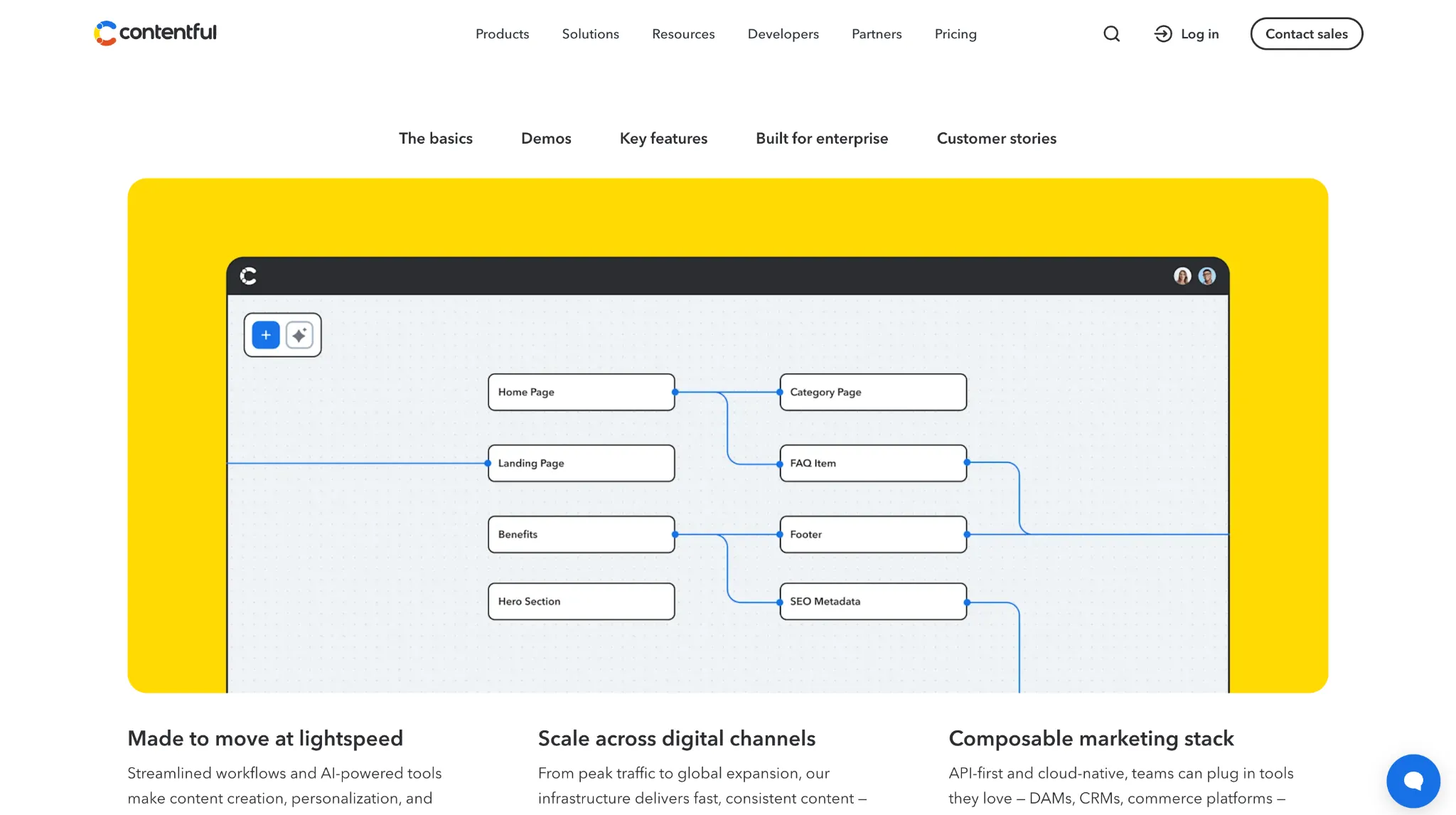
You log in, click fields into place, and your content model is live in minutes. No code required. That accessibility is a big strength for non-technical editors, marketing leads, and product managers: they can participate directly in shaping content models without a developer.
One G2 reviewer put it well:
"Contentful makes data modeling extremely easy. It takes minutes to build a database schema to create a new app."
The interface is polished, onboarding is fast, and most teams are productive within a day.
The trade-off is flexibility, and a ceiling you'll eventually hit.
Contentful forces every reusable element (a CTA block, an SEO field, a button component) to exist as its own content type with references. Contentful caps content types at 48 per space on paid plans, a limit that shows up repeatedly in developer forums.
As one developer wrote on Reddit:
"I've been most handicapped in the past by Contentful's limit of 48 content types. That's super tricky because content types are used a LOT in Contentful and you can quickly hit that limit. At which point you're totally screwed."
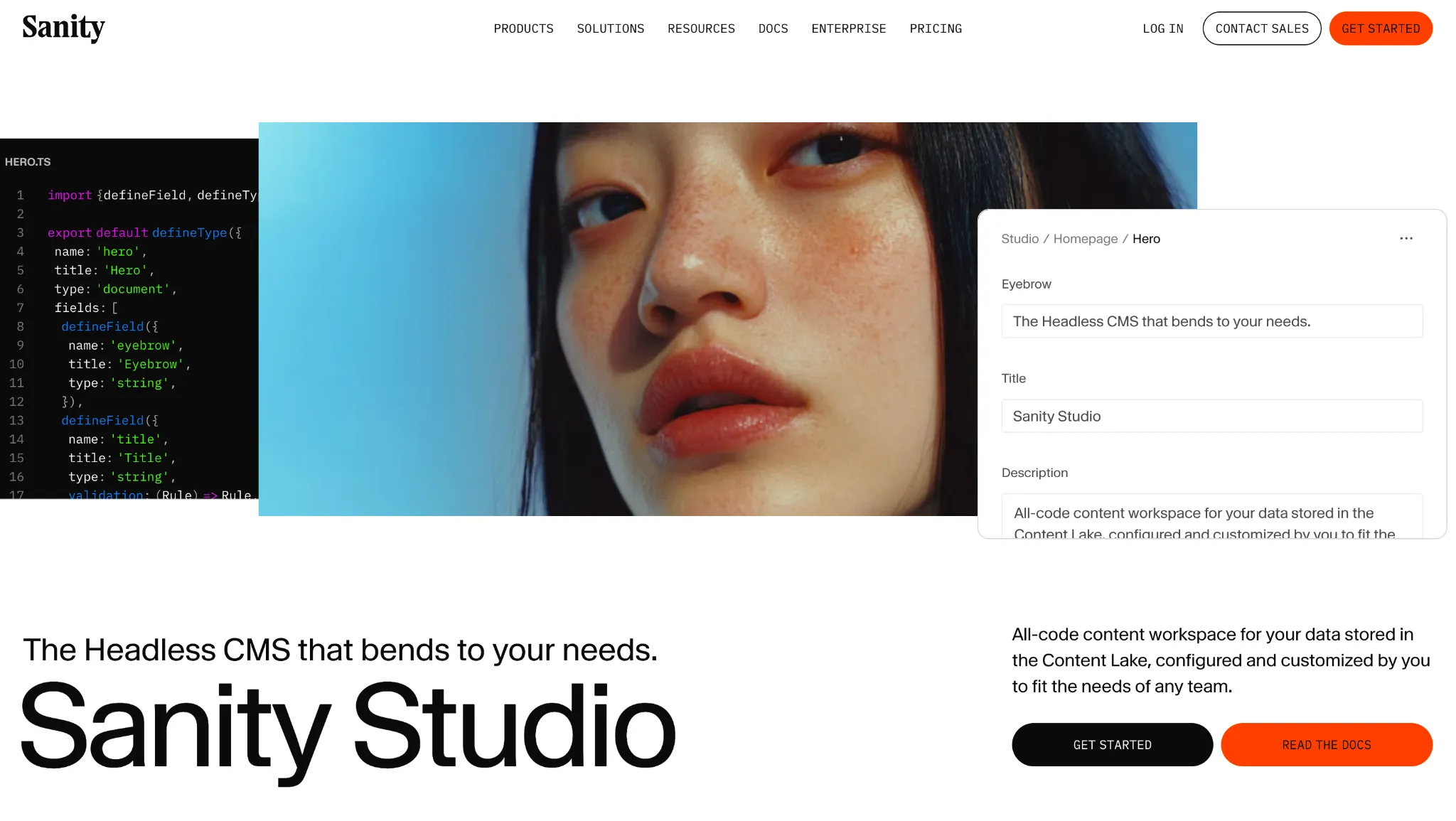
Content schemas are defined in JavaScript or TypeScript, live in your codebase, and travel through version control alongside your application. A developer needs to set up and maintain schemas but what you get in return is remarkable flexibility.
There's no content type cap, inline objects and references are both supported, and your entire schema history is right there in Git.
The editorial experience in Sanity Studio is also a differentiator.
It's an open-source React application you customize and deploy as part of your project. Multiple editors can work on the same document simultaneously, with live presence indicators and conflict-free merges, much like editing a shared Google Doc.
One G2 reviewer described the experience directly:
"The Sanity Studio is customizable, the real-time collaboration feels like Google Docs for content, and the GROQ query language makes pulling content easy."
On rich text: Sanity uses Portable Text, an open specification that stores block content as typed, serializable JSON objects. It's renderer-agnostic, meaning the same content can be pushed to React, Vue, Flutter, native iOS, or plain HTML using community libraries. Custom blocks (callouts, product cards, embedded media) are first-class citizens.
Contentful stores rich text in its own JSON tree format with embedded entries and assets; capable, but less portable if you're distributing content across multiple surfaces or channels.
Contentful gets teams up and running faster with less developer investment. Sanity rewards teams willing to configure it with a far more tailored and powerful editorial environment.
Both platforms work cleanly with every major modern frontend: Next.js, Astro, Remix, SvelteKit, Gatsby. But the developer experience diverges in a few key ways.
Contentful ships REST and GraphQL APIs out of the box, backed by a global CDN with solid caching. Its integration marketplace has 100-plus apps (HubSpot, Salesforce, Marketo, Shopify, Commercetools, Algolia, Cloudinary, and more) that marketing teams can enable with a click (no code required).
Contentful’s marketplace has grown significantly over the past several years, and the platform now handles 1.8 billion API calls daily. For enterprises that depend on a specific martech stack, that ecosystem maturity is a real advantage. You're far less likely to need a custom integration built from scratch.
Sanity uses GROQ (Graph-Relational Object Queries) as its primary query language. GROQ is closer to SQL for JSON than it is to GraphQL; it filters, projects, and joins references in a single expression that would require multiple REST requests or verbose GraphQL queries elsewhere.
A query like this is typical:
*[_type == "post" && published == true] | order(date desc)[0...10]{
title,
"author": author->{name, avatar},
"categoryTitles": categories[]->title
}
Sanity documentation is direct about the trade-off:
"While you can think of GraphQL as a replacement for RESTful APIs, GROQ is more like SQL for JSON — you can do way more with it."
Once a team is fluent, GROQ becomes a productivity multiplier. But the learning curve is real; it's the single most common complaint from new Sanity users on G2.
Most developers describe getting comfortable within a day or two; the same reviewers almost always say it was worth it.
The architectural centrepiece on Sanity's side is Content Lake: a real-time, globally distributed datastore that stores every document as queryable JSON with a full revision history.
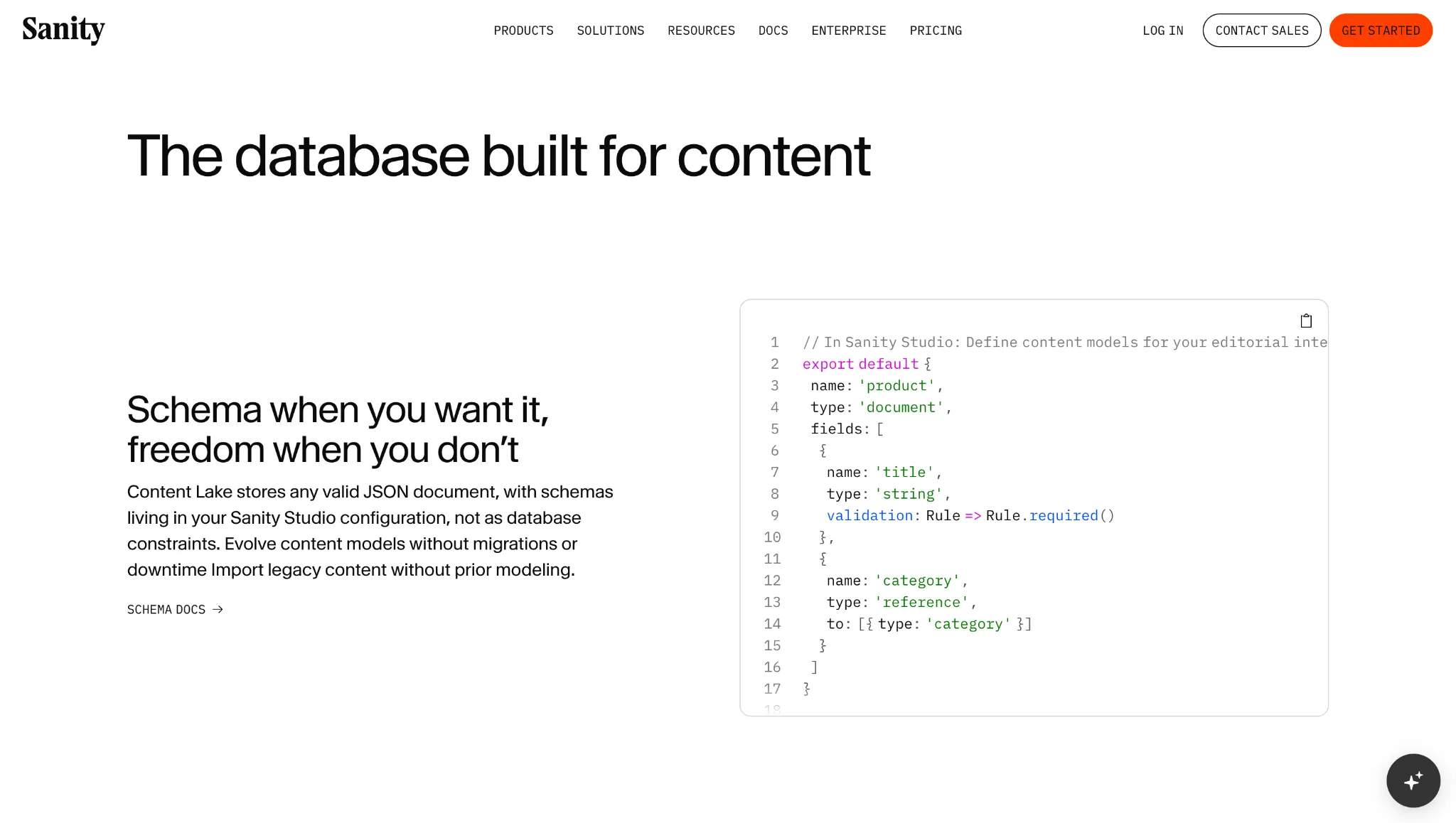
This is what enables Sanity's live collaboration and millisecond content delivery. Content changes are patched into the Lake, real-time listeners push updates to every subscribed Studio and frontend preview, and editors see changes instantly.
It's also why Sanity calls itself a "content operating system" rather than a CMS.
Sanity does support GraphQL as a secondary option, so teams with a strong preference for it aren't locked out. But GROQ is where the platform shines, and committing to Sanity means committing to learning it.
If your team needs a mature ecosystem with predictable integrations and familiar query patterns, Contentful's API surface and marketplace are hard to beat. If your team values expressive querying, real-time data architecture, and the ability to build custom content experiences, Sanity's developer experience is exceptional once you're past the initial ramp.
Both platforms offer free tiers, but they scale differently …
| Contentful Free | Sanity Free | |
|---|---|---|
| Users | 10 | 20 |
| Content records/docs | 10,000 (within 1 Starter Space) | 10,000 documents |
| Content types | 25 (capped in April 2025) | Unlimited |
| Locales | 2 | Unlimited |
| API calls/month | 100,000 | 1M CDN + 250K direct |
| Bandwidth | 50 GB | 100 GB |
| Real-time collaboration | No | Yes |
| Private datasets | Yes | No (public only) |
Worth noting: Contentful tightened its free tier in April 2025, capping content models at 25 (previously unlimited). Sanity's free tier is widely regarded as the most generous in the headless CMS market, though the 10,000-document cap is a hard limit (when you hit it, access pauses until the next billing cycle or you upgrade).
Sanity Growth starts at $15 per seat per month (Viewers are free).
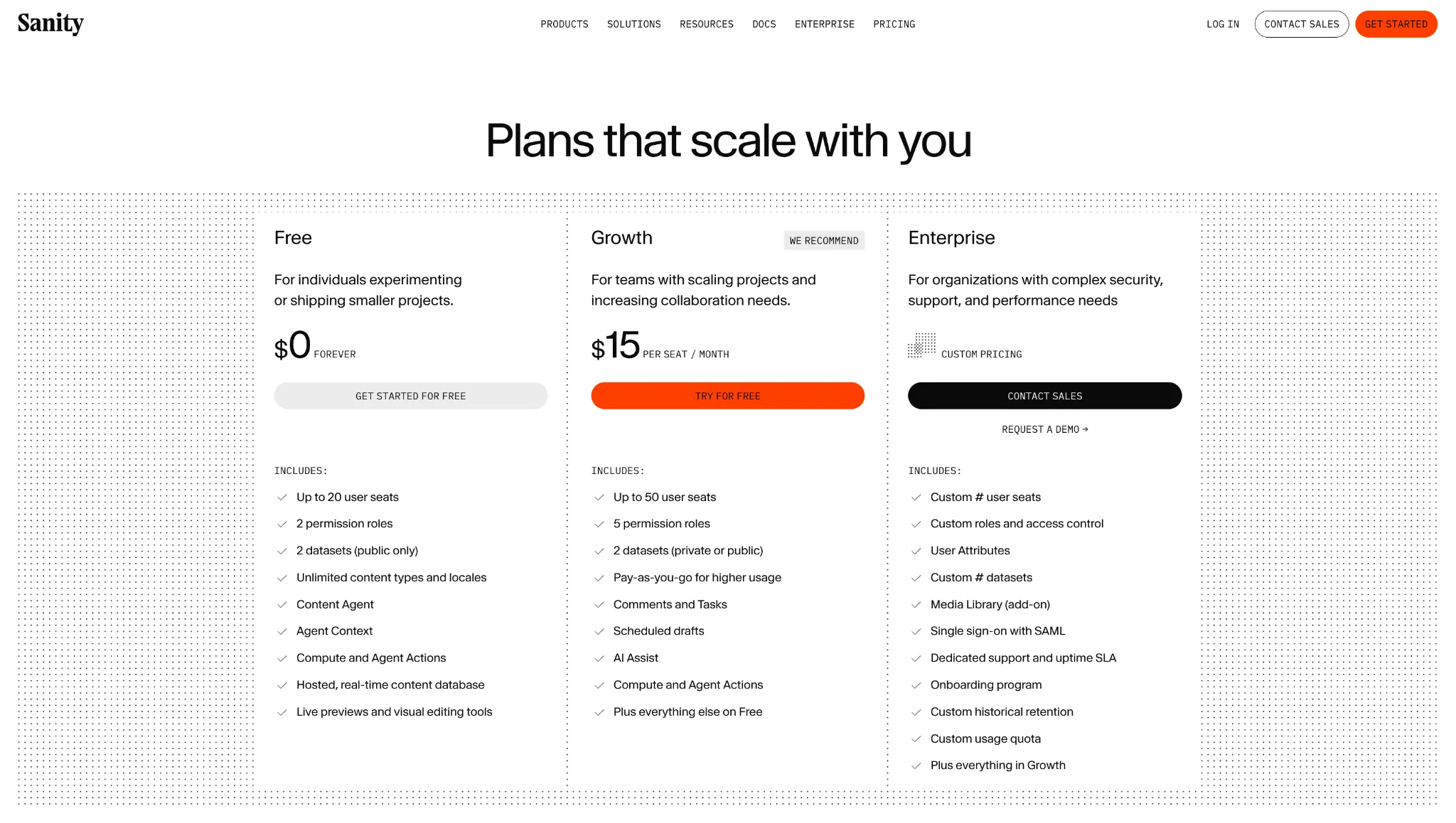
Contentful Lite starts at $300 per month flat for up to 20 users, but caps you at 25 content types on a Starter Space. Most production deployments require the Lite Space add-on at $850/month, putting realistic entry pricing closer to $1,150/month.
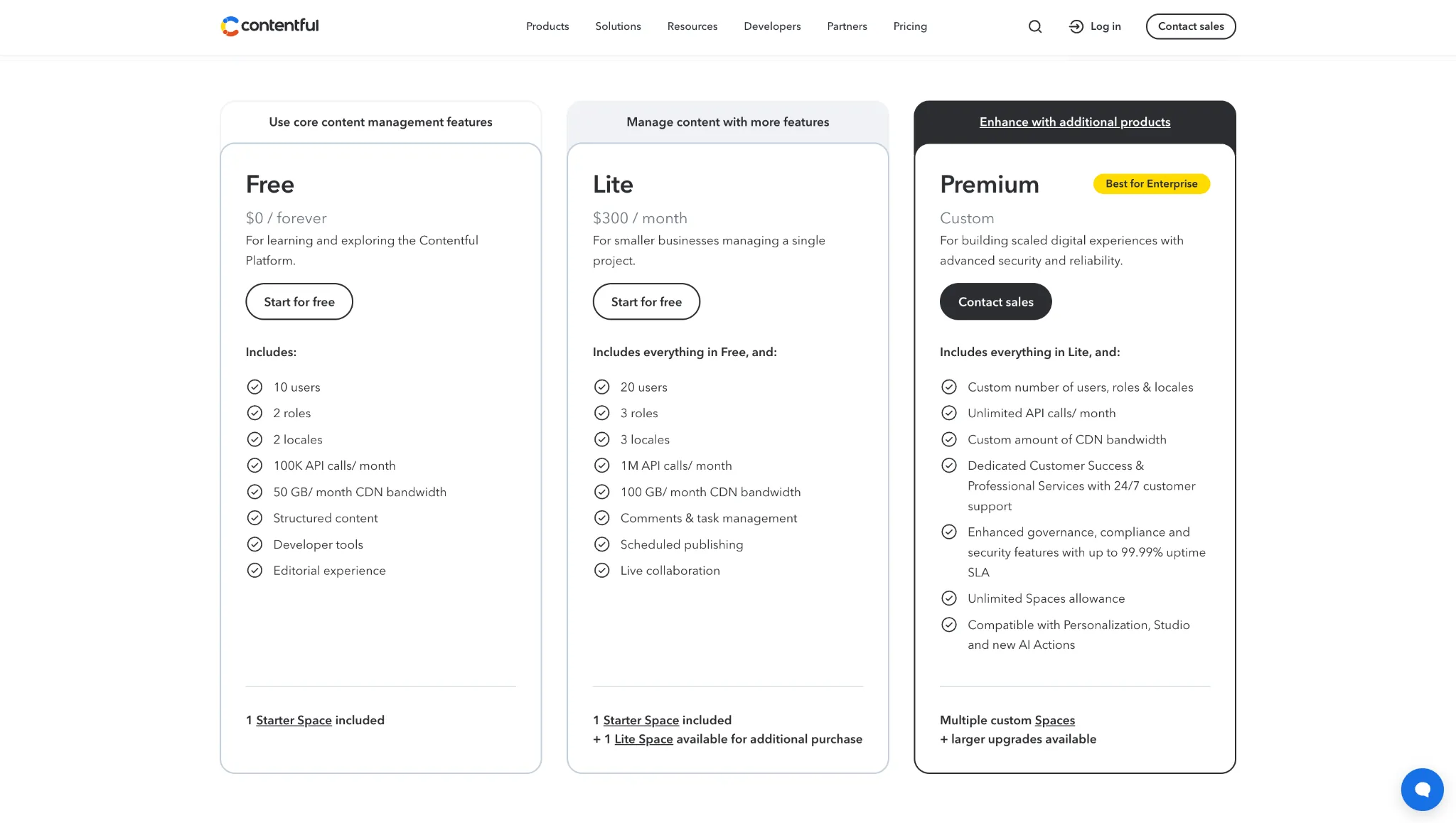
Here's what that looks like in practice:

.svg)