Content Marketing For Startups: The No-BS Guide
Most content advice is written for big teams with big budgets. This is the no-BS content marketing guide built specifically for startups.
Here's the situation most startups find themselves in: limited time, a small team, a runway that doesn't forgive waste, and a long list of channels telling you they're the answer to your growth problem … paid ads, influencer marketing, cold outreach, trade shows.
All of them cost money you don’t have, and most of them stop working the moment you stop feeding them.
Content marketing is different. It's not just "cost-effective". It's structurally different from every other channel because its returns compound over time rather than disapear once you pause spend. A well-written, well-optimized blog post can generate traffic and inbound conversions years after publication, at close to zero marginal cost. No ad delivers that.
The problem is that most content marketing advice is written for companies with a dedicated marketing team and a six-figure content budget. This guide isn't. It's built for founders and small marketing teams who need a practical, repeatable approach to content that gets results.
Why Content Marketing Works Differently For Startups
Let's reframe what content marketing means for an early-stage company, because the Fortune 500 playbook doesn't apply here.
The first thing to understand is why content is uniquely suited for startups.
You don't have brand recognition. You can't outspend competitors on paid media. And your sales team (which may just be you) can only have so many conversations and do so much outreach in a day. Content solves all three of these problems, and it does it on a timeline that compounds.
Consider what happens before a buyer talks to your sales team. According to 6sense's 2025 Buyer Experience Report, buyers mostly or fully define their purchase requirements 83% of the time before speaking with sales.
That means your content, your website, and your online presence are doing the selling long before a human ever gets involved.
This is especially true for B2B. 71% of B2B buyers start their research with a simple Google search, and over four-fifths trust organic search results over paid ads.
Buyers are forming opinions about your expertise, your credibility, and your fit before they ever book a demo. If your content is out there, findable, and useful, you're shaping that opinion. If it isn't, someone else is (i.e., your competitors).
There's also the compounding effect of content. Unlike paid ads, which stop delivering the moment you stop paying, content continues to earn traffic and generate leads long after it's published. Research shows that a well-ranking blog post continues generating organic traffic for an average of 3.5 years after publication. That's three and a half years of value from a single piece of work.
✅ The bottom line: Content marketing levels the playing field. A startup with a smart content strategy can rank alongside, and in many cases above, established players for the keywords their buyers are searching. You don't need a massive budget to win at content. You need the right strategy.
Start With The Bottom Of The Funnel, Not The Top
Don't start with top-of-funnel content.
Conventional wisdom says to write educational blog posts, build brand awareness, and let traffic trickle in. For a startup, though, that approach often means spending months generating page views that don't convert. That content might be generating traffic, but the conversion layer, the pages and content that actually close deals, is weak or nonexistent.
Think of it like opening a restaurant. You could spend months on a beautifully designed menu board in the window that draws people inside. But if there are no prices listed, no descriptions of the food, and no one around to answer questions, people walk back out.
That's what a startup looks like when it publishes top-of-funnel content before focusing on content that converts.
The smarter approach is to build your Bottom of Funnel (BOFU) content first, then expand upward. BOFU content targets buyers who are already in a buying motion. They're not wondering whether they have a problem. They’ve identified that they have a problem and they are comparing solutions, trying to decide what to choose.
💡Key insight: BOFU content converts at 5-10%, compared to under 1% for top-of-funnel content. The traffic volume is lower, but every visitor is worth dramatically more.
BOFU content for a startup typically looks like this:
Clear pricing pages with transparent feature breakdowns
Vague "contact us for pricing" pages are a conversion killer for buyers doing self-research.
Most buyers want to understand cost and scope before they speak to anyone. If you have a pricing page like this, visitors will click away (even if they would have signed up or requested a demo). One of your competitors will have more clear and visible pricing, and buyers will start there.
Transparency builds trust and pre-qualifies leads, meaning the conversations your team has are better qualified from the start.
Case studies and customer success stories
You don't need ten of these. Even one solid customer story, with specific numbers, a named company, and a clear before/after, is enough to begin.
Product-led content that shows real customers using your product to solve specific problems converts far better than generic educational content.
High-intent search content
When a buyer searches "[Your Competitor] alternatives" or "[Product A] vs [Product B]", they are ready to make a decision. Creating well-structured, honest pages or blog posts that target these searches puts you directly in front of high-intent buyers at the exact moment they're evaluating their options.
This is some of the most valuable organic traffic a B2B startup can earn.
When I was CloudZero (a B2B SaaS startup), these type of searches were some of the best at immediately converting website visitors from blog post to demo request. A buyer would search something like “Cloud Cost Managment Tools”, find our result at the top of Google, and then land on blog post like this:
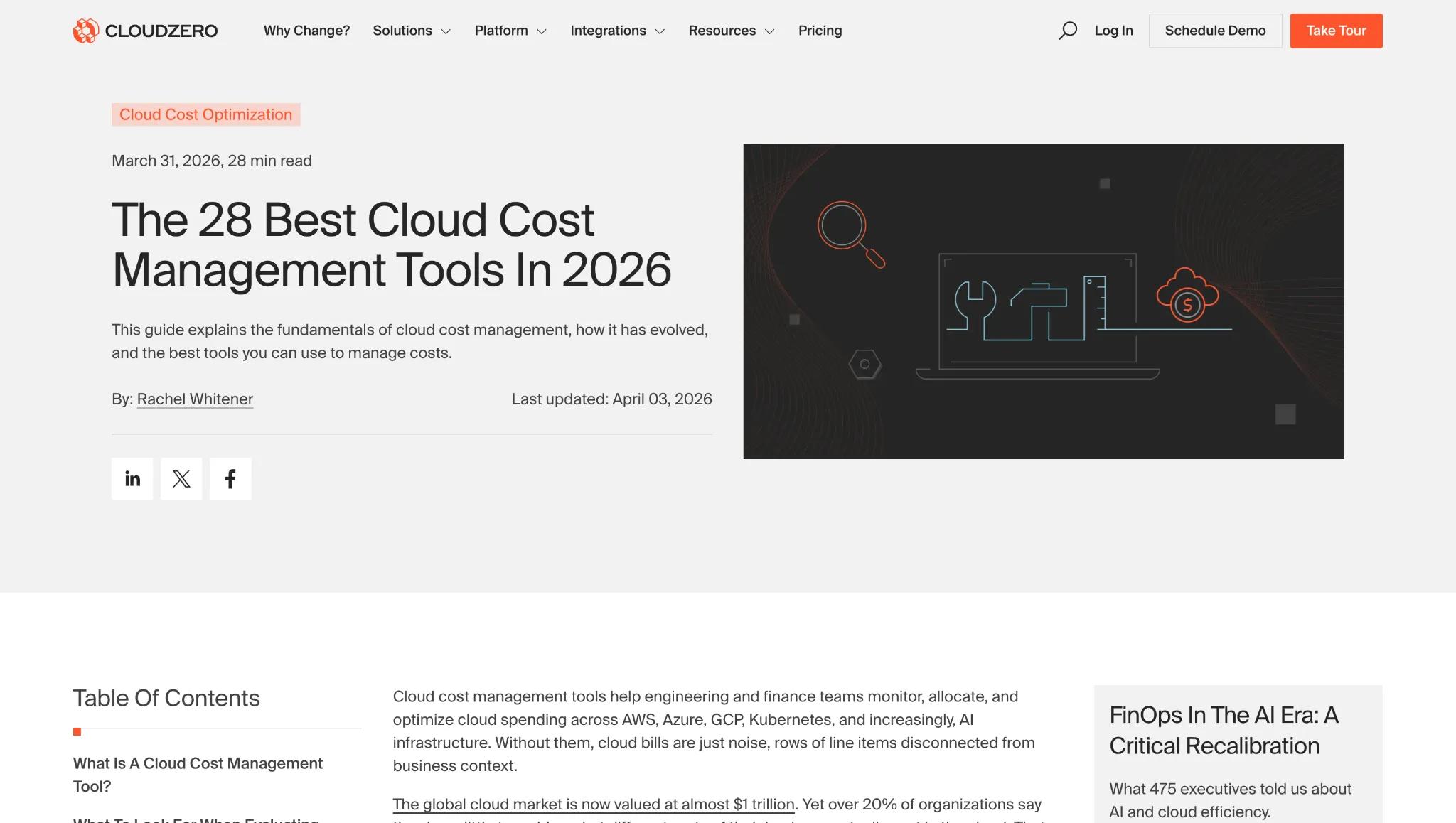
From there, we’d mention our own brand as one of the tools, and what separates us from competitors. Visitors would navigate to the home page or directly to the “Schedule Demo” page to request a demo.
There are several type of searches you can target like this:
- [Your Competitor] alternatives (e.g., “HubSpot alternatives”)
- [Product A] vs [Product B] (e.g., “Mailchimp vs MailerLite”)
- [My Product] tools (e.g., “Email marketing tools”)
Hit all of these type of keyword first before more generic, TOFU ones (e.g., “Email marketing best practices”, “How to create a newsletter”, etc.)
Once this conversion layer is solid and tested, then you build outward into educational and awareness content. Not before.
Building A Lean Content Strategy That's Actually Sustainable
The biggest mistake startups make isn't bad writing. It's trying to do too much, spreading resources too thin, and burning out within the first three months with nothing to show for it.
The fix is ruthless focus.
1. Define content pillars
Pick two to three content pillars that connect directly to your product and your ideal customer's most pressing pain points, and go deep on those. A content pillar isn't a broad topic like "productivity" or "data security." It's specific enough to own.
If you're building a B2B SaaS tool for HR teams, your pillars might be "employee performance tracking," "remote team management," and "HR reporting." Everything you write connects to one of those three themes.
2. Start with customer problems and keyword intent
Great content strategy requires both. Start by getting close to your buyers: go back through sales call recordings, look at your support tickets, and search Reddit threads and LinkedIn groups where your audience hangs out.
What questions come up again and again? What objections does your team hear repeatedly? These are your highest-value content topics, because they map directly to real problems buyers are trying to solve.
Then bring keyword research into the same process. Look for high-intent keywords that signal a buyer is close to making a decision. These include comparison queries "[Product A] vs [Product B]", alternative searches "[Your Competitor] alternatives", category tool lists ("Best project management software for agencies"), and pricing or review searches.
These keywords have lower search volume than broad educational terms, but the people searching them are actively evaluating solutions, which means they convert at a far higher rate.
When you can find a keyword that aligns with a real customer problem your product solves, that's your sweet spot: content that ranks, resonates, and converts.
3. Set a publishing frequency, and stick to it
Consistency always beats volume. Research shows that businesses that prioritize blogging are 13x more likely to achieve a positive ROI, but the key term is "consistently."
For a lean startup team, two quality long-form posts per month, published reliably, will outperform a sprint of daily posts followed by six weeks of silence. Two posts per month is an achievable, sustainable target for a founder or small startup team.
This cadence builds topical authority over time without burning out the person doing the writing.
💡 Pro tip: One practical way to protect that consistency is to remove friction from the publishing process itself. BlogSync automates publishing from Google Docs, Word, or Notion directly to your website CMS, handling formatting, cleaning HTML, and optimizing images. This turns a 20-30 minute manual publishing process per blog post into just a few seconds.
4. Focus on founder-led content
In the early days, the most powerful content a startup can produce often comes directly from the founder.
When Intercom's founders Des Traynor and Eoghan McCabe started sharing opinionated takes on building software companies, they built a "sizable reputation and audience" before they even had a formal content team. That reputation compounded into one of the most widely read B2B blogs in the world.
Drift's David Cancel built the company on personal storytelling and founder-driven content. According to RevBoss, within five years of launch, Drift had gained over 50,000 customers and achieved 20x revenue growth in a single year, with founder content as a core pillar of that growth.
Viktor Hendelmann, co-founder of GenViral, a bootstrapped content automation startup, built early traction almost entirely on founder presence rather than brand content.
"For GenViral, it's been a lot of X traditionally, because when we launched it a year ago, my co-founder had 8K X followers and I had already quite a bit as well."
That personal audience became the company's growth engine before there was a content strategy. He's since expanded into YouTube for the same reason, publishing daily videos that walk through how he personally uses the product to solve a specific problem, rather than talking about the product directly. "The actual video shows a product... this is how I can use it," he says, describing how a tutorial-style video draws people in with a generic search term and lets them discover the product naturally within it.
The reason founder-led content performs so well is simple: buyers trust people before they trust brands.
Founder-led content simplifies complex ideas, builds personal credibility, and creates demand in a way that traditional corporate content can't replicate. A founder who writes candidly about a market problem they've lived with has an authenticity that no amount of agency-produced content can match.
Content Types & Channels Worth Your Time
The temptation to be everywhere is strong and almost always counterproductive. LinkedIn, TikTok, a podcast, a YouTube channel, a newsletter, a blog, a community. Most early-stage teams that try to do all of these end up doing none of them particularly well.
The question to answer first is: where does your audience already spend time, and what can your team realistically produce and sustain week to week?
For most B2B startups, the highest-ROI combination looks like this:
Long-form SEO blog posts
HubSpot's State of Marketing research consistently ranks website, blog, and SEO efforts as the number one ROI-driving channel for B2B brands.
Posts that answer specific, high-intent questions your buyers are actively searching for will generate compounding organic traffic long after publication. Aim for thorough, genuinely useful content.
The average first-page Google result contains around 1,447 words, and long-form content generates significantly more backlinks and social shares than thinner posts. It’s quality over volume.
LinkedIn for founders and leadership
LinkedIn has over 830 million users, with one in four being senior decision-makers. For B2B startups, it remains the most effective platform for building an audience of buyers quickly.
The format rewards authentic, opinionated posts: lessons learned, contrarian takes on industry assumptions, observations from customer conversations.
I’d suggest using attention-grabbing images or videos whenever possible in your posts. These are likely going to stop someone scrolling their feed, and get more impressions. For example, here’s a post I made on LinkedIn, comparing SEO vs. AEO/GEO, with a colorful graphic that easily compares the two:
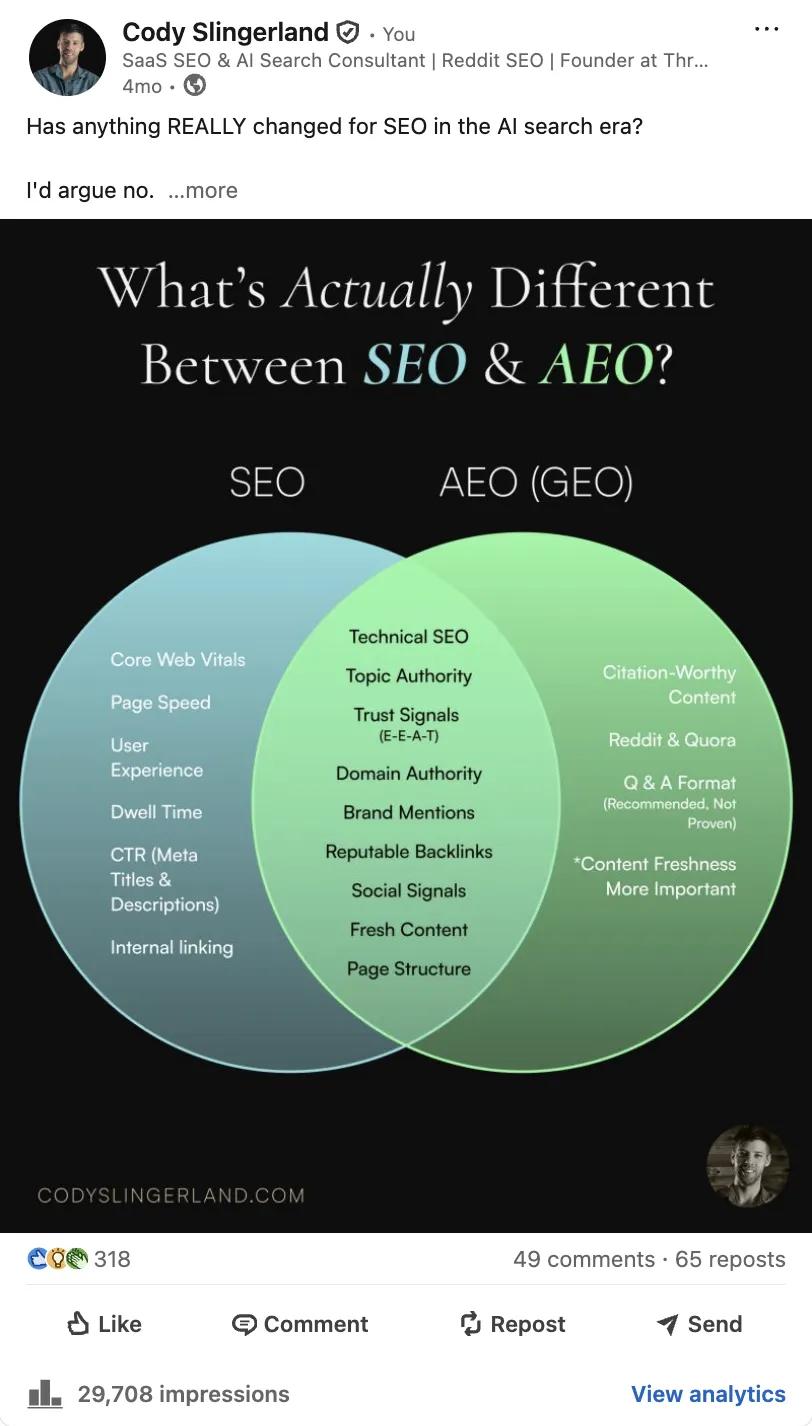
This post ended up going viral and getting nearly 30K (most of my posts at the time were getting 500 to 1,000 views).
The strategy is to test ideas on LinkedIn first, then expand the highest-performing topics into full blog posts.
Email newsletters for nurturing leads
Email marketing delivers an average ROI of $42 for every $1 spent, making it one of the highest-performing channels available. Even a simple monthly digest, curating your best content and sharing one useful insight, keeps your audience warm.
The goal isn't to sell in every email. It's to remain present and useful so that when a subscriber is ready to buy, you're top of mind.
Repurpose content
This is the one that small teams consistently underuse. One well-researched, long-form blog post contains the raw material for three LinkedIn posts, an email snippet, a pull quote for social, and maybe even a short video script.
Building a simple repurposing cadence into your content workflow effectively multiplies the reach and lifespan of every piece you produce without requiring additional creative effort. Every piece should work harder than once.
The good news is you don't have to do this manually. Tools like Unifire and Tugan.ai are built specifically for this workflow.

Paste in a blog URL or article, and both tools generate LinkedIn posts, email newsletters, and social snippets in one pass. For a small team already investing time in quality long-form writing, either tool turns one well-researched post into a week's worth of distribution.
Metrics That Actually Matter For Startup Content
Vanity metrics are seductive. Page views, social follower counts, and impressions feel like progress because the numbers are big. But they also tell you almost nothing about whether your content is producing business results.
Here are the five metrics to watch instead, and why each one matters:
1. Organic traffic growth, month over month
Not the total number, but the trend. Is your organic traffic curve moving consistently up and to the right?
A healthy content program shows a compounding growth line over time, not a flat line with occasional spikes from a single viral post.
2. Keyword ranking improvements
Track the specific keywords you're targeting and monitor whether your pages are climbing in search results. Google Search Console is free and shows exactly which search queries are driving impressions and clicks to your site.
But you can take it a step further by using Ahrefs’ Rank Tracker:
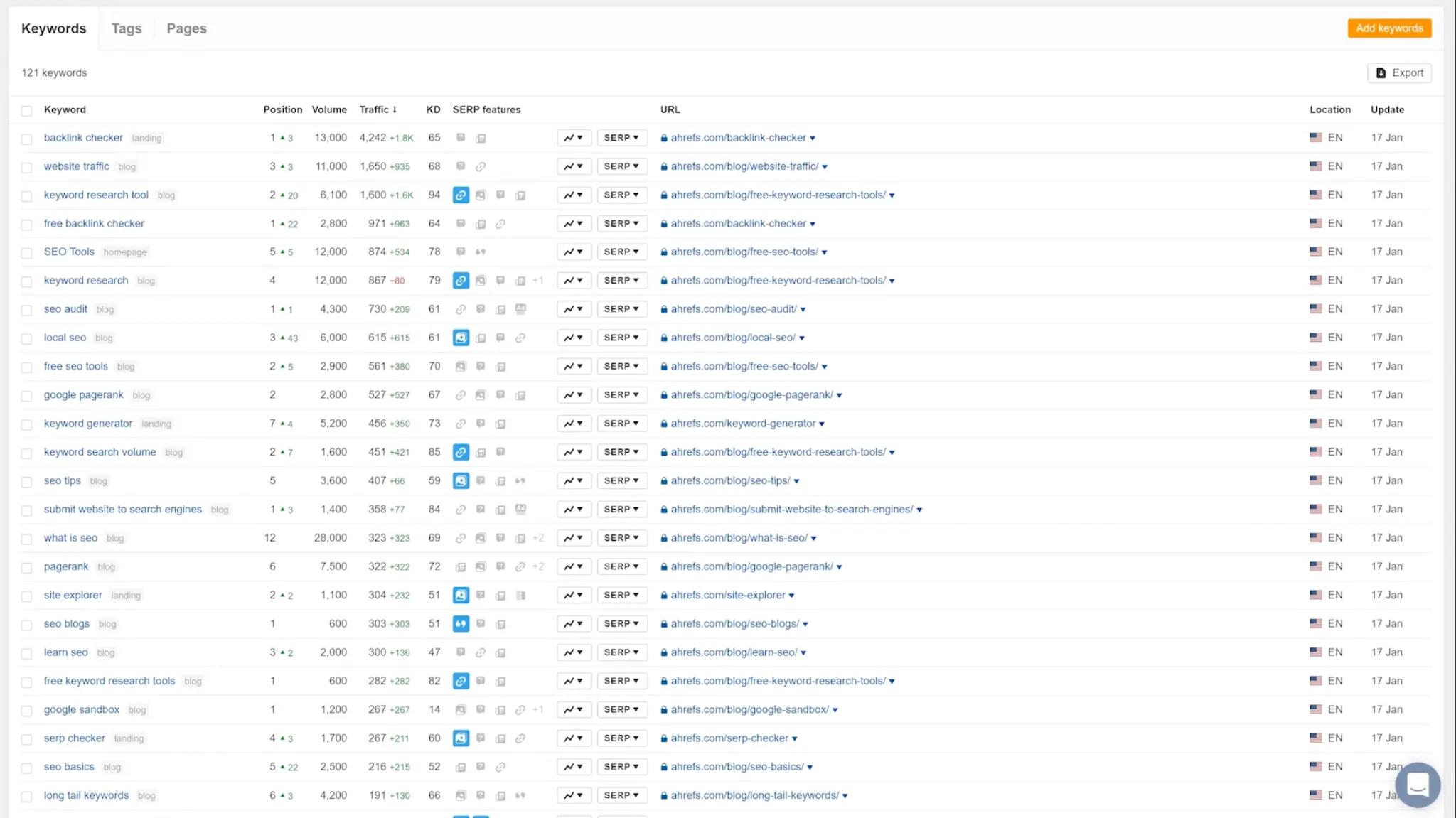
Add all the keywords you want to track (you can also tag high-intent keywords to filter by them later), and track their rank progress over time. I recommend having one target keyword per page or blog post. It’s very likely that if you rank for these keywords, you’ll also rank for related keywords.
But having one target keyword makes it easier to monitor and see if you’re climbing in ranking with the target URL (i.e., the blog post or page you created to target that keyword).
3. Content-sourced conversions
This is the metric most startup content programs fail to track, and the most important one to monitor. Is the content you produce actually leading to results? In other words, signups, demo requests, form fills, etc.
As the Head of Content at Runn discovered using HubSpot, tracking a single high-intent blog post revealed it accounted for 15% of the company's total revenue. Without that tracking, it would have looked like just another mid-traffic page.
4. Email subscriber growth
If you're running a newsletter, subscriber growth is a direct signal that your content is valuable enough for people to invite into their inbox. It's also an indicator of future pipeline, since your subscriber list is the warm audience most likely to become customers over time.
Subscriber growth is a direct signal that your content is valuable enough for people to invite into their inbox, and it's one of the most important assets a startup content program can build.
Pro tip: One of the most effective ways to accelerate subscriber growth is through lead magnets on your blog. A well-positioned guide or checklist that goes deeper on the topic a visitor is already reading about gives them a reason to provide their email address at the moment of highest interest. Once someone is on your list, you can continue to educate and nurture them with relevant content until they're ready to buy.
5. Time on page as a content quality signal
If visitors are landing on posts and leaving within a few seconds, the content isn't delivering what they came for. If they're spending three or four minutes reading, that's a strong signal of genuine value. Pair time on page with scroll depth in your analytics to get a complete picture.
Review these metrics often
The most important habit is reviewing these five metrics together, monthly, and connecting content performance to business outcomes.
Founders and leadership need to see the link between content activity and pipeline/revenue growth to stay committed to a channel that takes time to compound.
A simple one-page monthly report showing organic traffic trend, top-converting content, and any direct attribution to signups or demos tells that story clearly, without requiring a full analytics overhaul.
Content marketing is a long game.
The teams that win aren't necessarily the ones with the biggest budgets or the most content. They're the ones who build a focused, consistent, well-measured system and stay in it long enough for the compounding to take effect.
The Content Workflow Problem No One Talks About
Creating great content is only half the battle. The publishing workflow is where time quietly disappears, and for lean startup teams, it's a surprisingly common reason content programs lose momentum.
Most content marketers spend more than 20-30 minutes per blog post on the publishing process alone, outside of writing. Copy from Google Docs into your website CMS, reformat broken headings, optimize and name images, re-upload thoses images, fill in metadata, the list goes on and on.
Across a team publishing 20 articles a month, that's roughly 32 hours of repetitive work every month (nearly a full work week) that adds zero strategic value.
The fix isn't more headcount. It's removing the friction.
BlogSync automates publishing from Google Docs or Word directly into your CMS (supporting WordPress, Webflow, HubSpot, Ghost, Sanity, and more), handling formatting, cleaning HTML, and optimizing and naming images, so publishing takes minutes rather than an hour.
For a small team where consistency is everything, that kind of operational shortcut is often the difference between a post going live on schedule and quietly slipping to next week. Give BlogSync a try for free here.