The 15 Best Content Audit Tools Worth Knowing In 2026
Stop publishing your way out of content decay. Discover the best content audit tools to keep your existing content fresh, visible, and competitive.
Most content teams don't have a content creation problem. They have a content decay problem. So many marketers focus on the next blog post, keyword, or content brief that they lose sight of all of their amazing existing content.
Somewhere in the archives of your blog live posts that once sat comfortably at the top of Google. Now? They’re slowly losing traffic, becoming less relevant, and being outranked by your competitors.
And let’s be honest, it’s easier (and more fun?) to create new content. It’s also a common growth strategy. Already producing one post per week? Up it to two, then four, then five, and so on. But that can only work for so long. Soon you’ll have hundreds of articles, and all of those posts require upkeep.
Building and maintaining a successful blog requires more than just creating new content. It means making sure your content stays fresh, accurate, and reliable; something that’s especially important in the AI search era.
To help you create and maintain the best content possible, I’ve put together this list of the best content audit tools available today, organized by two important stages of the content audit process: Search Performance and Content Evaluation.
But before we cover the tools, let’s first cover why auditing your existing content is so important.
Why Should You Care About Auditing Your Content?
Most published content goes absolutely nowhere; nearly 97% of all web pages receive zero organic search traffic, and only 5.7% of newly published pages ever crack Google's top 10 within a year.
Yet, teams keep publishing more and more content. AI search further complicates this problem: 80% of LLM citations don't rank in Google. That means a page can rank well in Google but be completely invisible to AI-generated answers.
Publishing your way out of the problem doesn't work. You need to understand how your content is performing, what’s working, and what’s not in both Google and AI search. A proper content audit will help you do both.
There are several questions you should answer during a content audit:
- Is my content better than what’s already ranking? Your content will fail to perform if 1) it doesn’t meet search intent, and 2) it isn’t better than what’s already showing up in search. Why should Google, Perplexity, or ChatGPT show your content over your competitors? Is it more thorough? Does it provide unique insights or original research? Is it more up-to-date? Does it cover more subtopics? You first need to understand your content quality and be able to create something that is better than your competitors. This should be a key piece of your content creation strategy and audit strategy.
- Does my content show up in search (Google or AI), and does it actually drive traffic? So many blog posts lead to absolutely zero results; no traffic, no conversions. If it’s been a while since you first published your content (e.g., six months), and it’s still not showing up, it might need a refresh, or you might need to rethink your strategy.
- Does my content show signs of decay? Content decay is the slow process of a page’s traffic and rankings declining over time. Let’s say your blog post did what you wanted; it ranked for your target keyword and brought in tons of new website visitors. But that success will only last so long if your content doesn’t stay up-to-date and relevant. It may take months, or maybe years, but it’s inevitable. Rankings slip, competitors catch up, and traffic declines. You need to find the content that is starting to slip, identify why, and develop a plan to fix it.
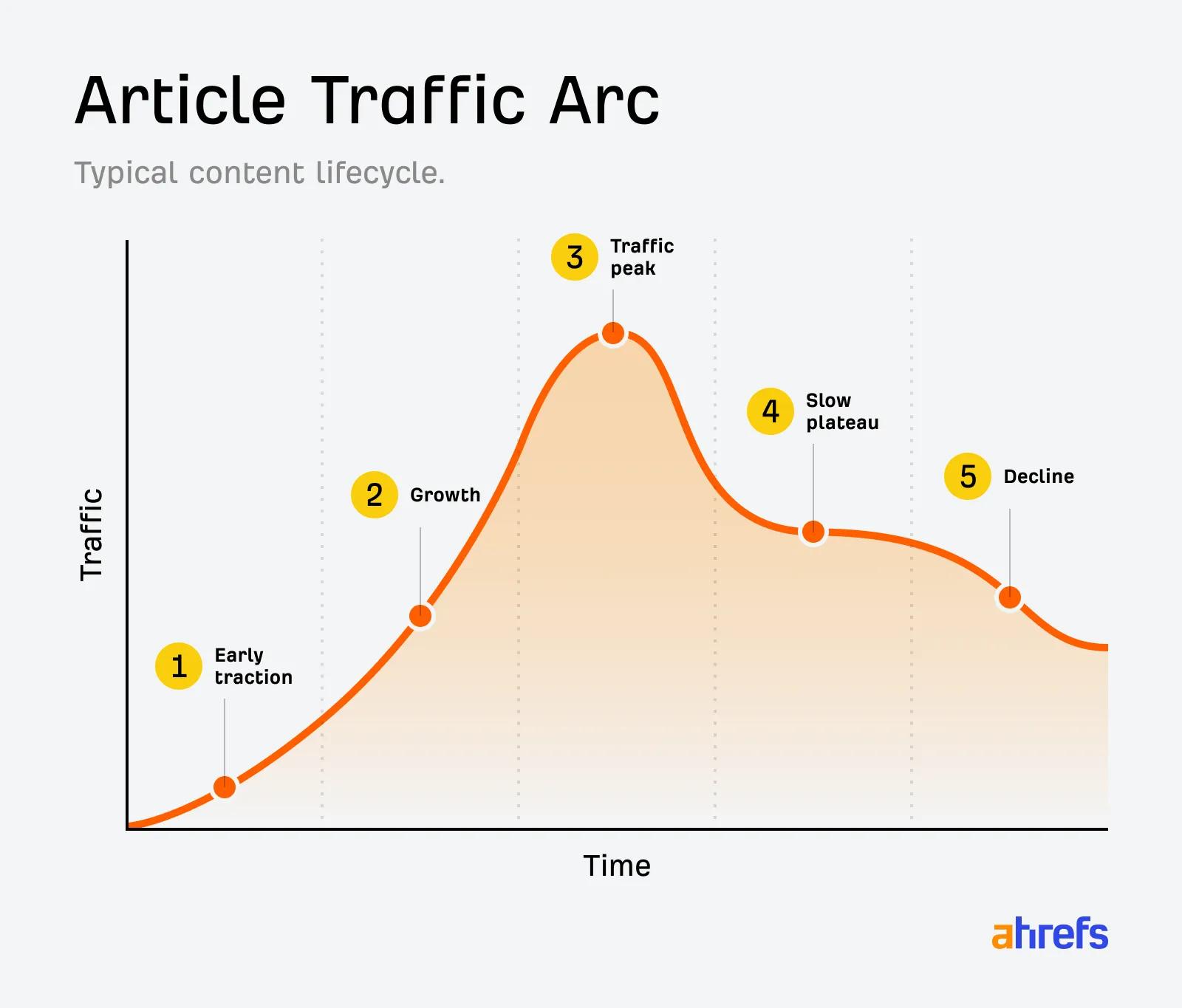
Things like content age, freshness, internal keyword cannibalization (i.e., multiple pages on your website competing for the same keyword), and competitors creating better content than you are the most impactful factors affecting your content performance.
If you want a deeper dive into content decay, Ahrefs has a good article, “What Is Content Decay? (And How to Fix It Before It Tanks Your Traffic)”. So, I won’t cover this in depth. The content audit tools in this article hit the critical points: content research, technical SEO, content quality, optimization, and AI search visibility.
The Best Content Audit Tools, Organized By Use Case
I’ve organized this list into two main categories:
- Search Performance. These tools help you measure your performance in Google and AI search (ChatGpt, Perplexity, AI Mode, etc.) and/or can help you identify technical issues on your website (like crawlability, indexing, etc.)
- Content Evaluation & Optimization. These tools help you evaluate topical depth, freshness, readability, and E-E-A-T signals rather than just flagging technical errors.
Most teams need more than one tool. Technical SEO tools tell you what exists and what's broken. Search performance data shows what’s showing up in search and getting traffic, and what’s starting to slip. A content quality layer tells you whether what exists is actually good.
Search Performance & Technical SEO
Google Search Console & GA4
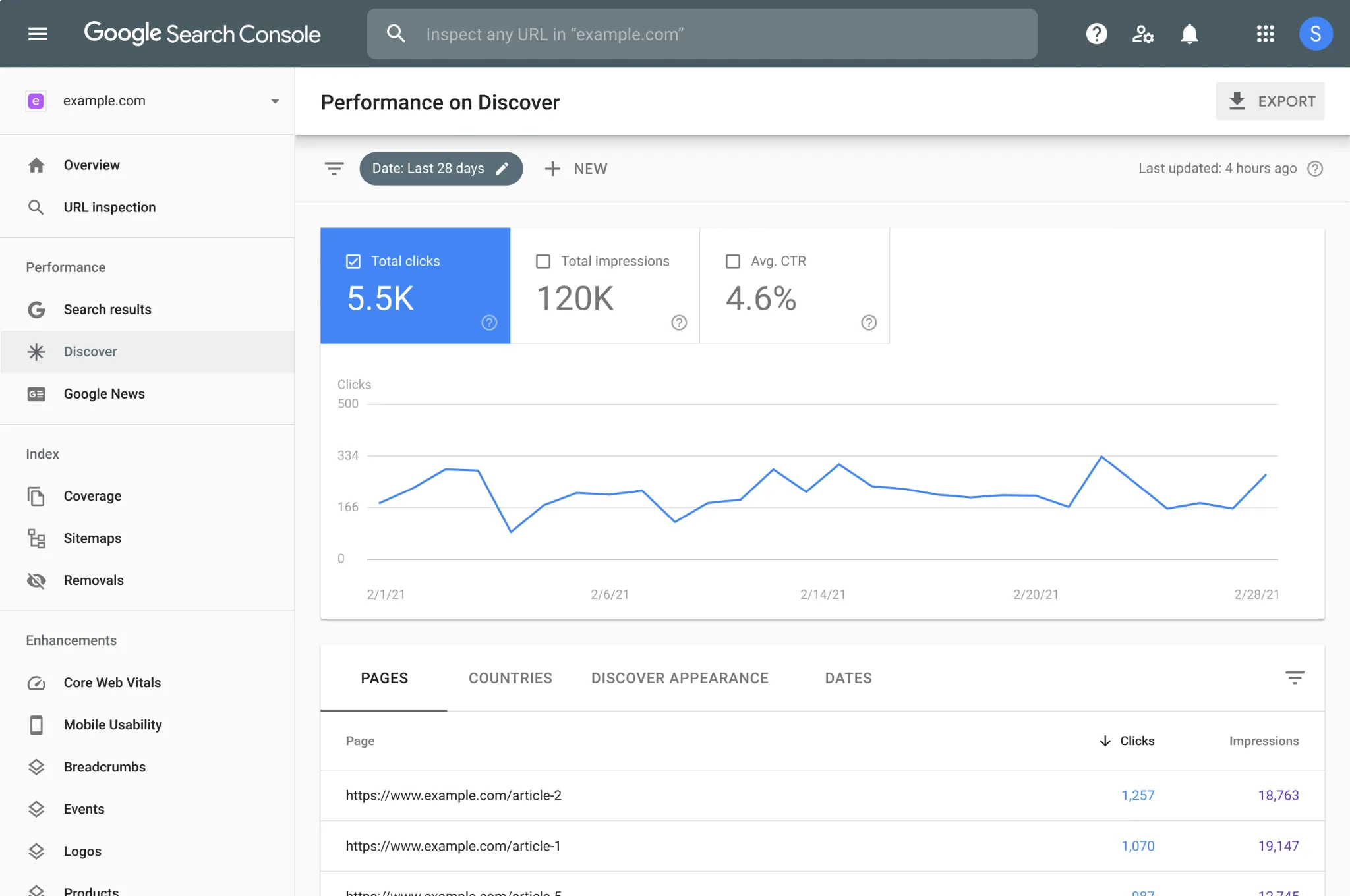
Google Search Console (GSC) and Google Analytics (GA4) are where every site audit starts.
GSC shows you how Google sees your content: which queries result in your pages being shown in SERPs, how often they appear, how many clicks they get, and whether there are any site indexing issues you should resolve.
GA4 shows you what users actually do when they arrive: sessions, engagement rate, conversions, and content drop-off.
Pricing: Free.
Limitations: GSC data is capped at 16 months. Exporting and cross-referencing at scale requires manual spreadsheet work. Neither tool has automated issue detection or content quality scoring.
Best for: Every team as the starting point before choosing a paid tool.
Ahrefs Site Audit
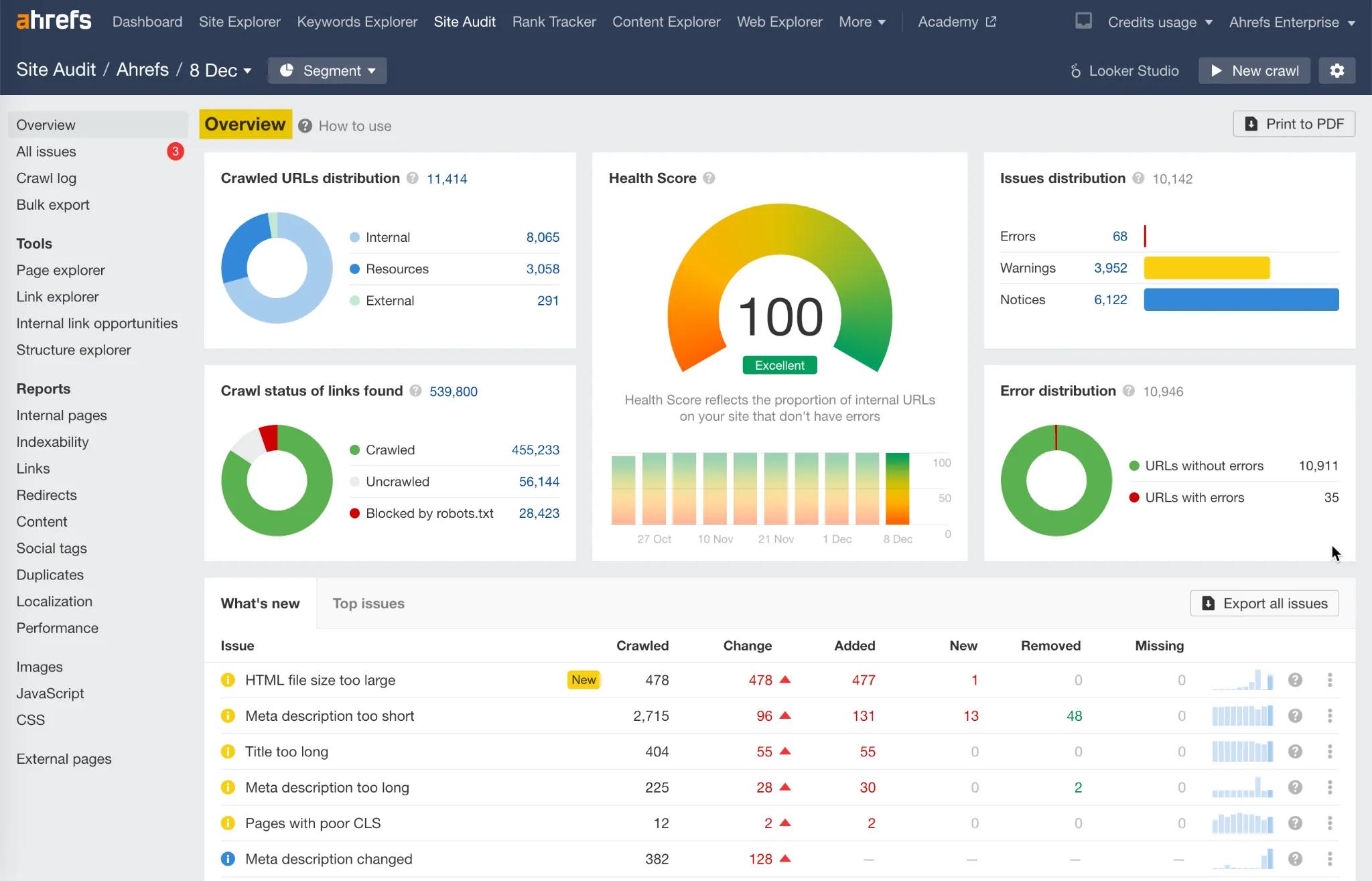
Ahrefs has three valuable features to a content audit workflow worth calling out: Site Audit, Rank Tracker, and Brand Radar. Site Audit crawls your entire site for over 170 SEO issues, covering thin content, broken links, duplicate tags, crawlability problems, and Core Web Vitals signals, and then displays them in a prioritized health score dashboard.
Rank Tracker monitors keyword positions over time with daily or weekly updates, allowing you to spot declining pages before traffic loss becomes significant. Brand Radar is Ahrefs' AI visibility monitoring product, showing how your brand appears across ChatGPT, Perplexity, Gemini, Copilot, Google AI Overviews, and Google AI Mode.
Pricing: Starter $29/month (new as of Jan. 2026); Lite $129/month; Standard $249/month; Advanced $449/month. Enterprise $1,499/month.
Limitations: Brand Radar's add-on pricing is steep, with full six-platform coverage running $800-$1,000+ per month when combined with a base subscription. Cloud-based crawling is constrained by credits on lower-tier plans. No free trial on paid plans.
Best for: Teams that want site audit, keyword rank tracking, and AI visibility monitoring all in one platform.
Screaming Frog SEO Spider
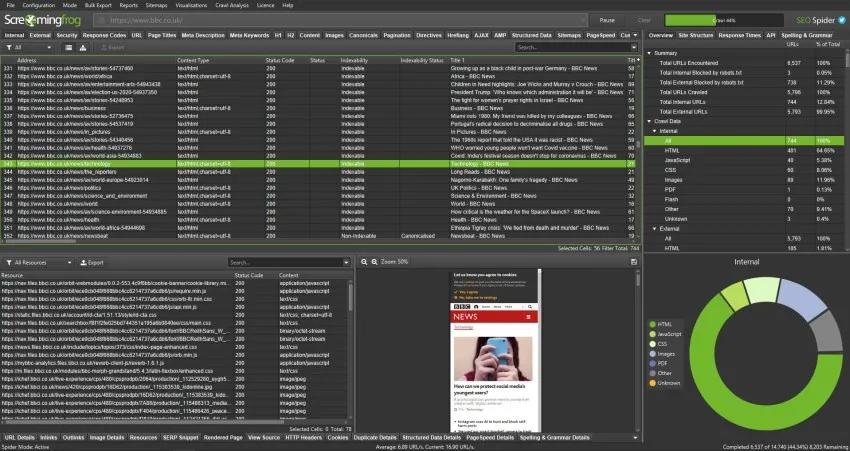
Screaming Frog SEO Spider is the closest thing the industry has to a universal standard for technical site crawls. It runs locally on your machine, crawls your site the way Googlebot would, and surfaces over 300 types of issues, including broken links, redirect chains, duplicate titles, missing metadata, orphan pages, and more.
Pricing: Free version (handles up to 500 URLs with no time limit); Paid license is £199 per year (~$279 USD)
Limitations: Screaming Frog provides raw data only. It shows you what's broken, but not which broken things matter most or how to fix them.
Best for: Technical SEOs, agencies, and any team running a technical deep-dive audit.
Profound
Source: SourceForge
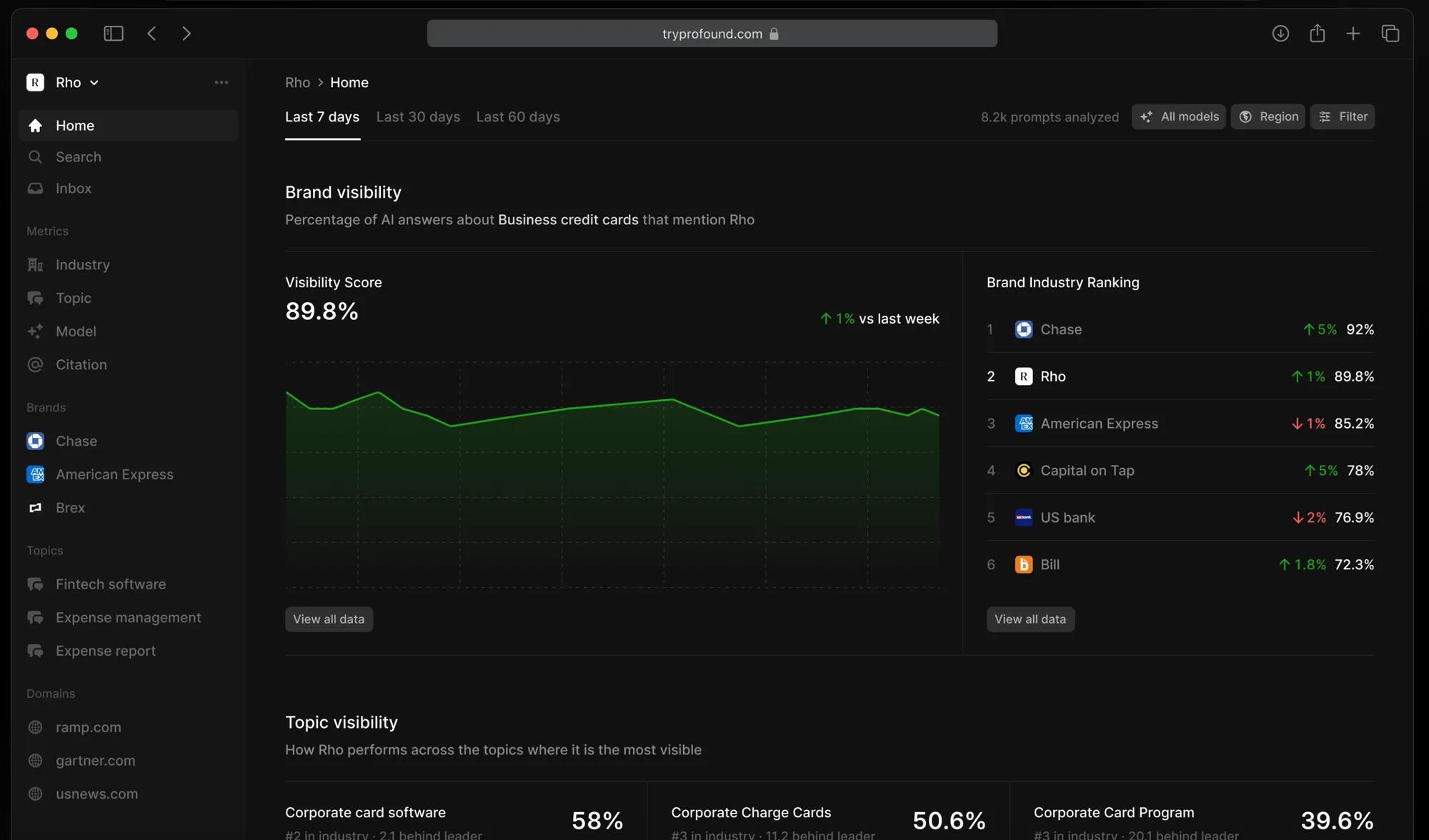
Profound is the enterprise leader in GEO intelligence. It tracks brand and content visibility across 10-plus AI platforms, including ChatGPT, Claude, Perplexity, Google AI Overviews, Gemini, DeepSeek, and Google AI Mode.
Its Prompt Volumes feature provides real user prompt data at scale, showing exactly what people search in AI and the search volume behind each prompt.
Pricing: Starter $99/month (ChatGPT tracking only); Growth $399/month (broader AI engine coverage); Enterprise custom. No free trial. Must request demo.
Limitations: The Starter plan only covers ChatGPT. Meaningful multi-platform coverage requires the Growth plan at $399/month. Primarily a monitoring platform with limited workflows or functionality for fixing identified gaps.
Best for: Enterprise brands with significant budgets, compliance requirements, and a need for the most comprehensive AI visibility data available.
Scrunch
Source: AEOTools.space
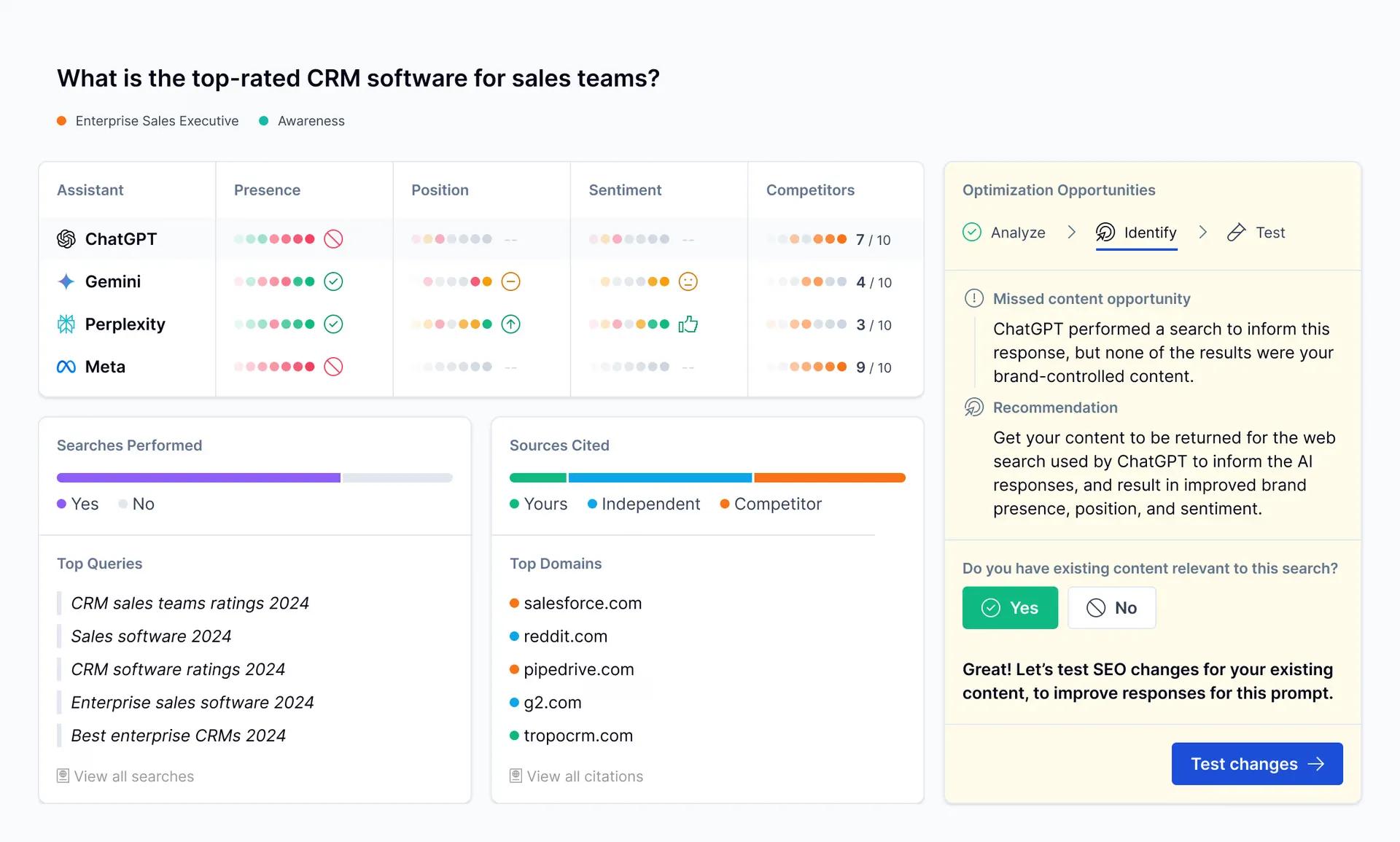
Scrunch covers the full GEO stack from monitoring to content delivery. Its site audit checks your robots.txt configuration for AI bot access, evaluates content structure for LLM synthesis, and scores content delivery speed for token-efficient processing.
The platform's Agent Experience Platform (AXP) automatically serves AI-optimized versions of your content when AI bots visit your website.
Pricing: Brand Core $250/month (350 prompts); Agency Core $500/month; Enterprise custom. 7-day free trial available.
Limitations: The AXP feature is only available on the enterprise plan. No execution layer for fixing identified content gaps. Entry price ($250/month) puts it out of reach for small businesses and individuals like consultants or freelancers.
Best for: Mid-market and enterprise teams wanting a dedicated end-to-end GEO platform with brand monitoring and AI bot optimization.
GEO Audit Tool
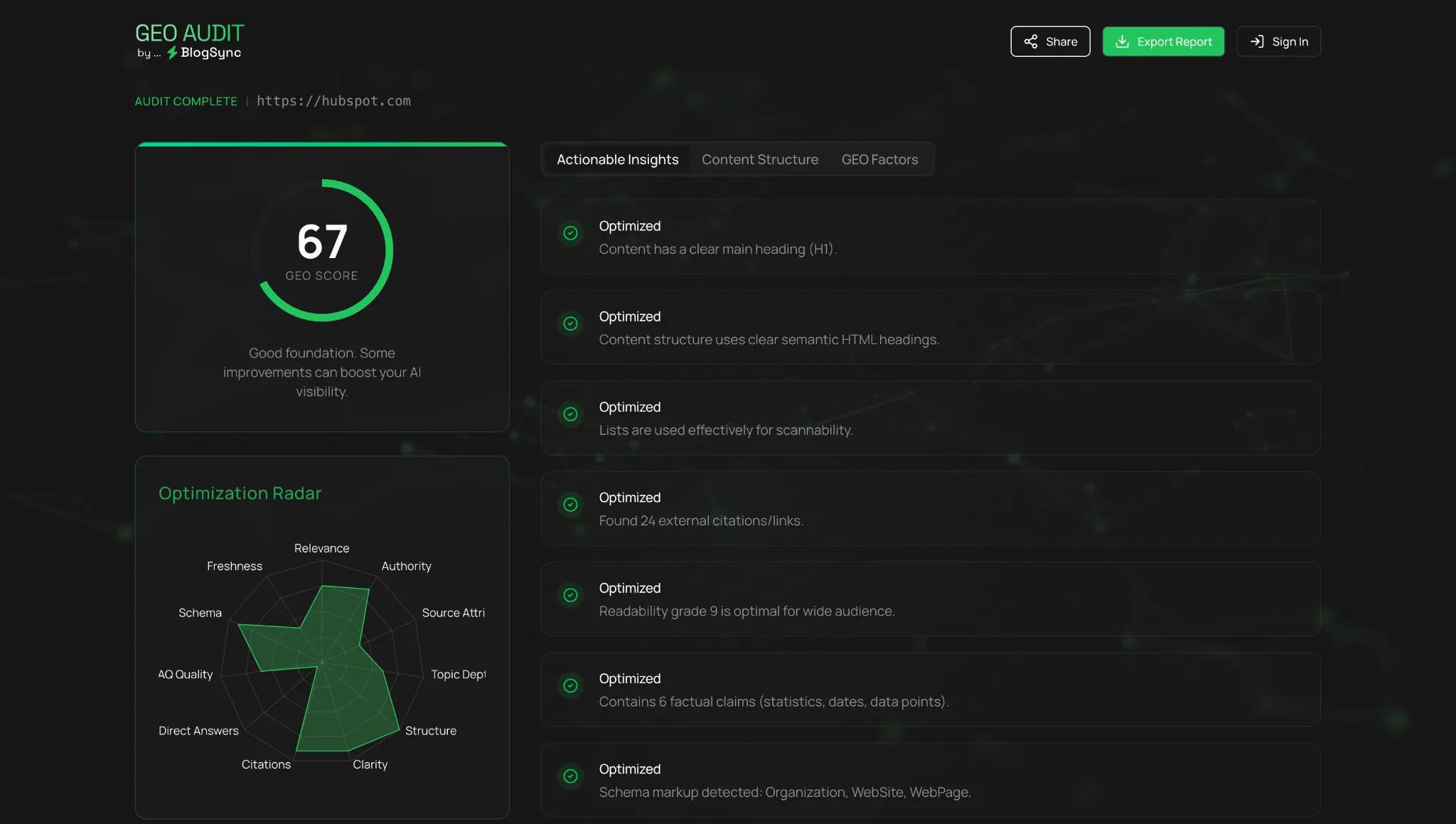
GEO Audit Tool is a free tool for auditing your site’s GEO visibility and readiness. It’s a simple tool, so nothing near tools like Profound or Peec. But it will give you a GEO score, which evaluates criteria like page relevance, freshness, schema, structure, and clarity, among other factors.
Additionally, you can embed the tool on your website, which, if you’re an agency, can be a good way to drive new leads and create engagement on your website.
Pricing: Free.
Limitations: A one-time snapshot rather than ongoing monitoring. Less depth than enterprise GEO platforms like Profound or Scrunch AI for continuous tracking. Designed as a diagnostic starting point, not a full monitoring solution.
Best for: Teams running their first GEO audit, or anyone who wants a fast, free baseline on how well their most important pages are built to be cited in AI-generated answers.
Honorable mentions
- Sitebulb a standalone desktop and cloud-based website crawler that runs full site audits. It checks over 300 SEO issues and organizes findings into visual charts and crawl maps. Screaming Frog does pretty much the same thing at a lower annual cost, but for agencies where client-ready reporting is a priority, it's worth a look.
- Lumar (formerly DeepCrawl) is an enterprise-grade cloud crawler built for large, complex sites that need pre-production SEO testing, log file analysis, and compliance-grade infrastructure. The barrier is the price: Vendr estimates annual contracts run between $14,500 and $93,400, which puts it out of reach for most teams who would be better off with Screaming Frog or Ahrefs Site Audit.
Content Evaluation & Optimization
Clearscope
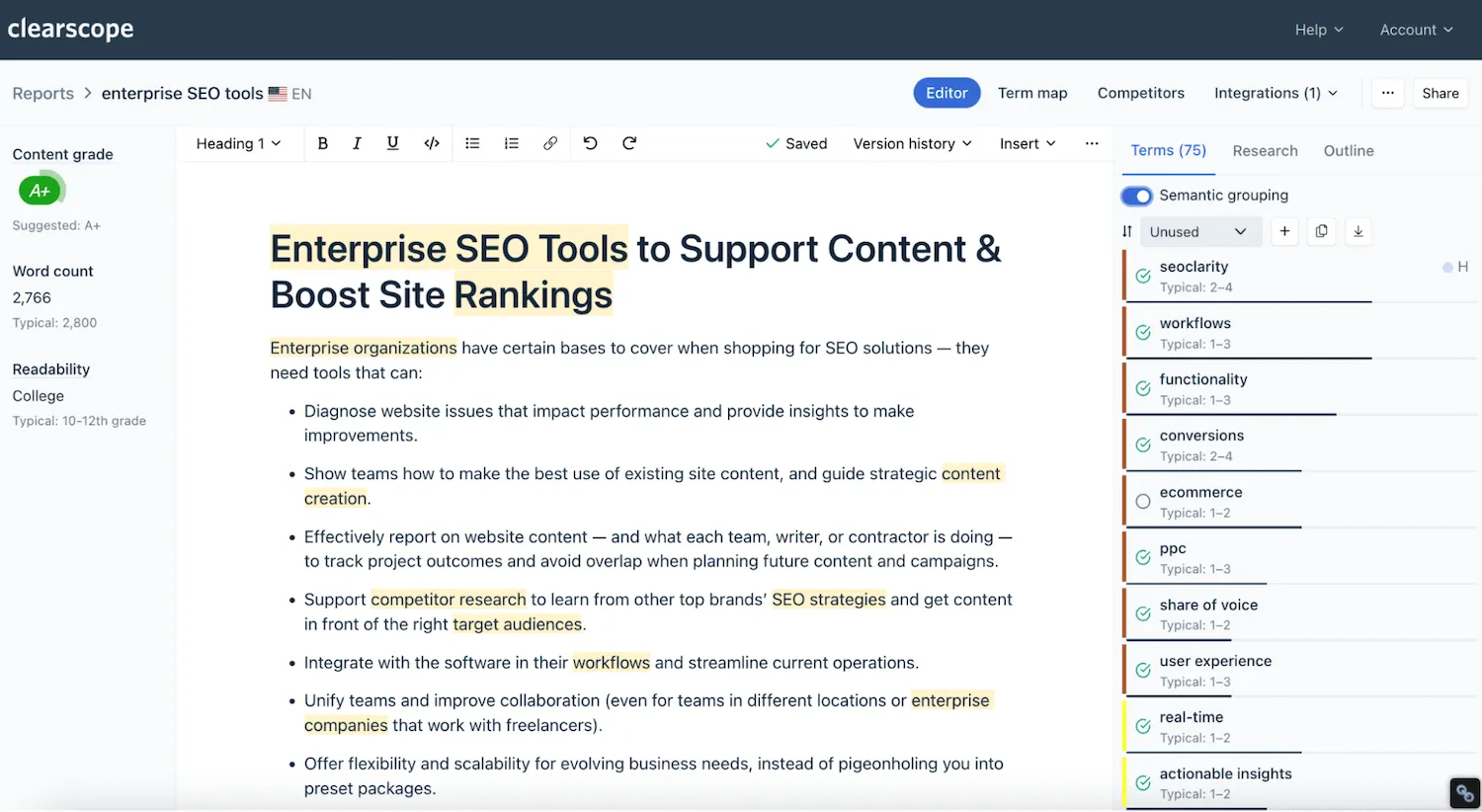
Clearscope is an all-in-one content optimization platform. But the two most relevant features here are its content inventory and writing tools. Content Inventory provides an overview of your content, which content is performing well, which pages are declining in traffic, and which pages are being cited in AI search. This can help you identify content that could be updated to improve search performance.
Clearscope’s writing editor (what it’s most known for) provides keyword density in relation to other top-ranking results, and features a text editor with AI writing/editing features. Beyond that, Clearscope also has keyword/topic research, tracked topics, and AI content generation (similar to Jasper, Writesonic, Copy AI, etc.).
Pricing: Essentials $129/month (20 tracked topics, unlimited users); Business $399/month; Enterprise custom. No free trial.
Limitations: The $129 entry price puts it out of reach for freelancers and very small teams. There’s also no free trial or free plan. So you need to request a demo to see that platform.
Best for: Content editors and writers focused on improving the quality and topical depth of specific underperforming pages.
AirOps
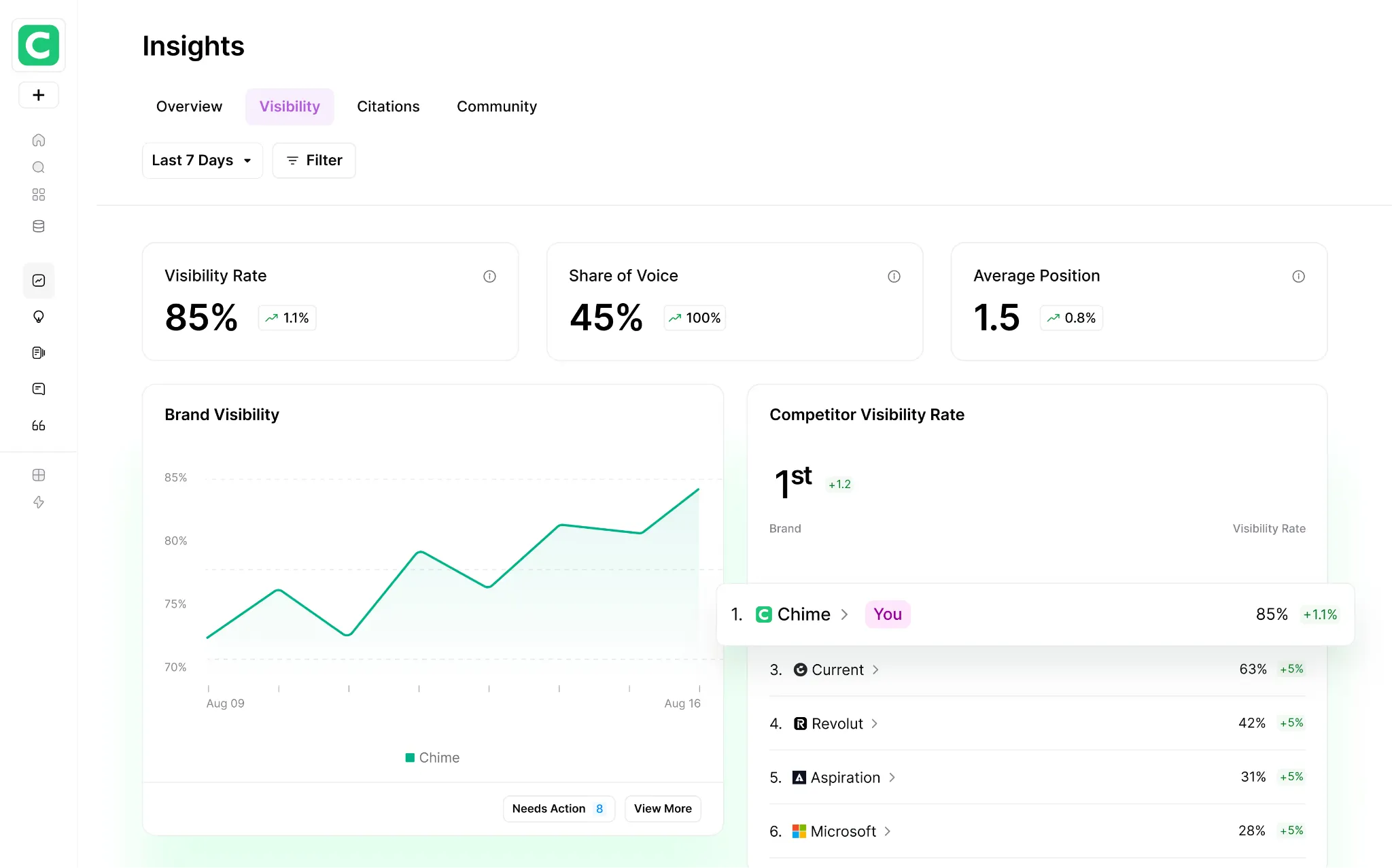
AirOps’ platform is a blend of content optimization and GEO visibility. While its AI search visibility isn’t quite as in-depth as something like Profound or Peec, AirOps excels at identifying content optimization opportunities and automating content creation.
Its Page360 dashboard combines AI search visibility data with traditional GSC and GA4 metrics to identify which content needs refreshing and why, then provides workflow automation to automatically update or create new content.
Pricing: No public pricing (though reviews state pricing starts at $200/month). 14-day free trial available.
Limitations: AI search visibility tracking is a secondary capability, not the core product. The task-based billing model on higher plans can make costs unpredictable. Works best for teams that already have a proven content strategy and need to execute it faster, not teams still building their foundation.
Best for: High-volume content teams who have been consistently creating content for some time and need to scale their content refresh strategy.
StoryChief
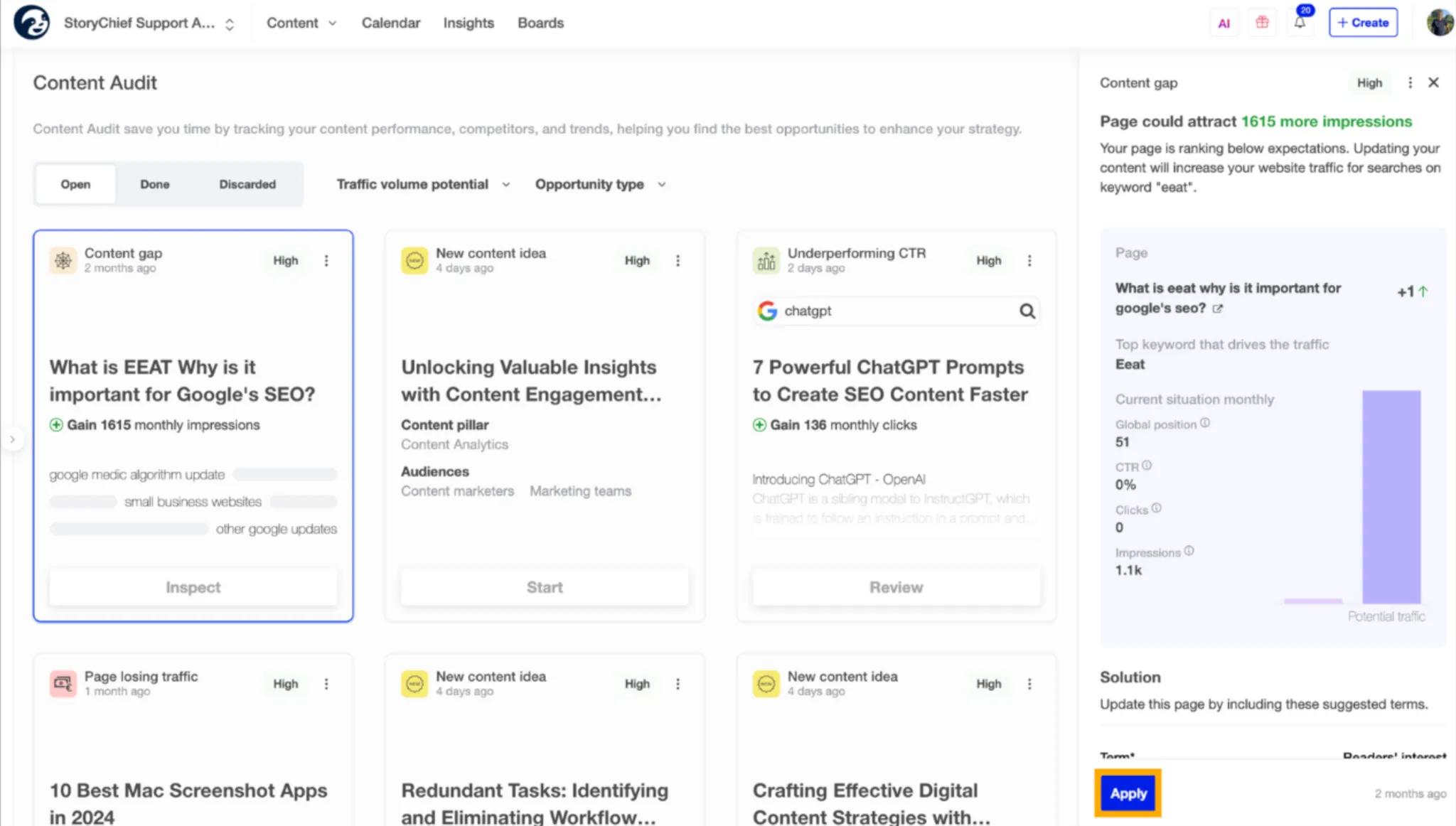
StoryChief is a content management platform. It has a content calendar, AI-powered content editing, automated content publishing, and content audits.
Its Content Audit feature connects to Google Search Console and automatically flags pages losing traffic, surfaces content with underperforming click-through rates, identifies topic gaps against competitors, and recommends new content pillars, all automatically refreshed weekly.
Pricing: Team Editorial (includes Content Audit) $81/month/seat. Team Discounts custom pricing. 7-day free trial available.
Limitations: The Content Audit feature is supplementary to StoryChief's core publishing and scheduling product, not a standalone audit tool. Teams needing deep technical SEO analysis or granular keyword data will still need a dedicated technical SEO tool (like Ahrefs, Semrush, etc.).
Best for: Content marketing teams who want continuous audit insights, multi-channel publishing, and editorial workflow management in one place.
Surfer SEO
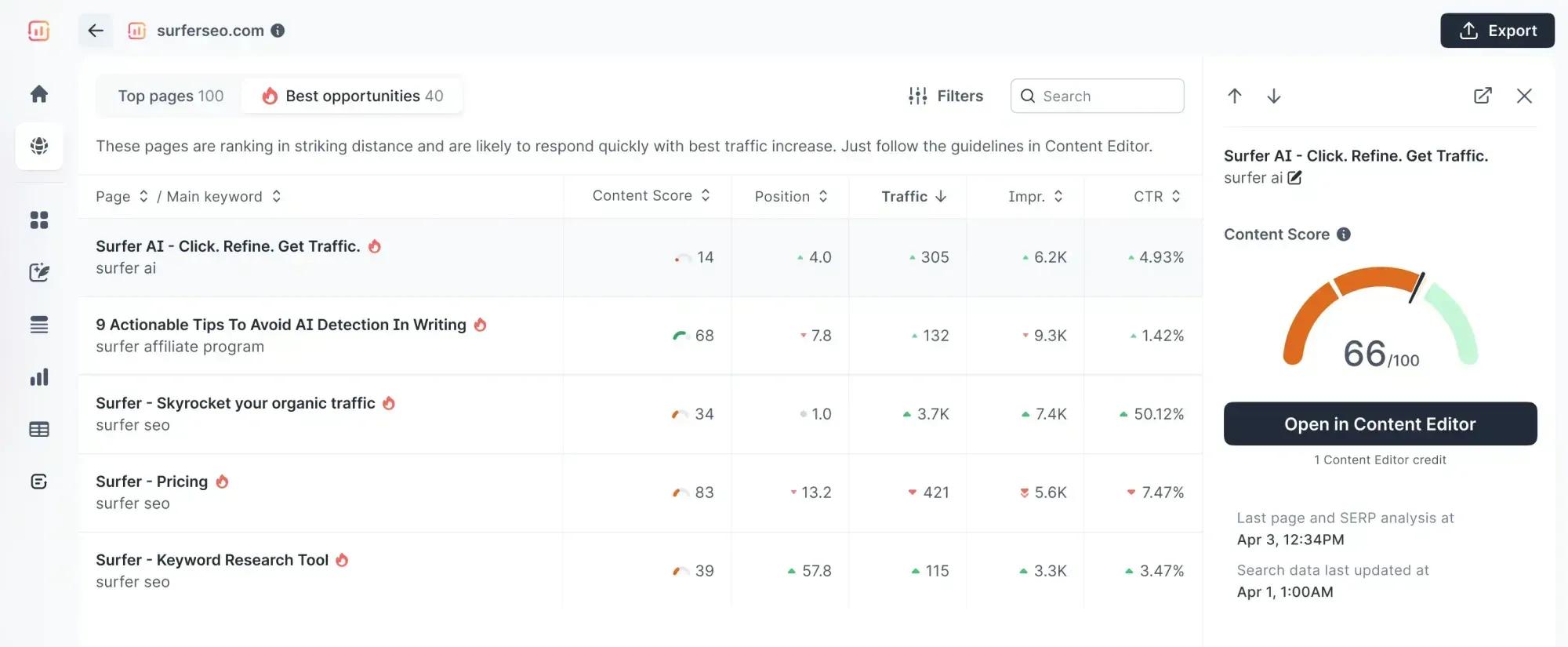
Surfer SEO is one of the most widely used and well-known content optimization tools today. Its Content Editor scores your content against 20 to 50 top-ranking competitors for a target keyword and generate a Content Score from 0 to 100 based on word count, keyword usage, heading structure, and NLP terms. It also integrates natively with Google Docs, WordPress, and ChatGPT.
The Content Audit tool connects to your GSC account, flags rank drops as they happen, and surfaces weekly quick-win recommendations.
Pricing: Discovery $59/month; Essential $119/month; Pro $219/month; Peace of Mind $359/month; Enterprise $999/month. No free trial.
Limitations: No technical site crawl capabilities.
Best for: Content teams producing at volume who want a data-driven optimization loop, from new content creation through to ongoing auditing and rank-drop monitoring, all in one platform.
Frase
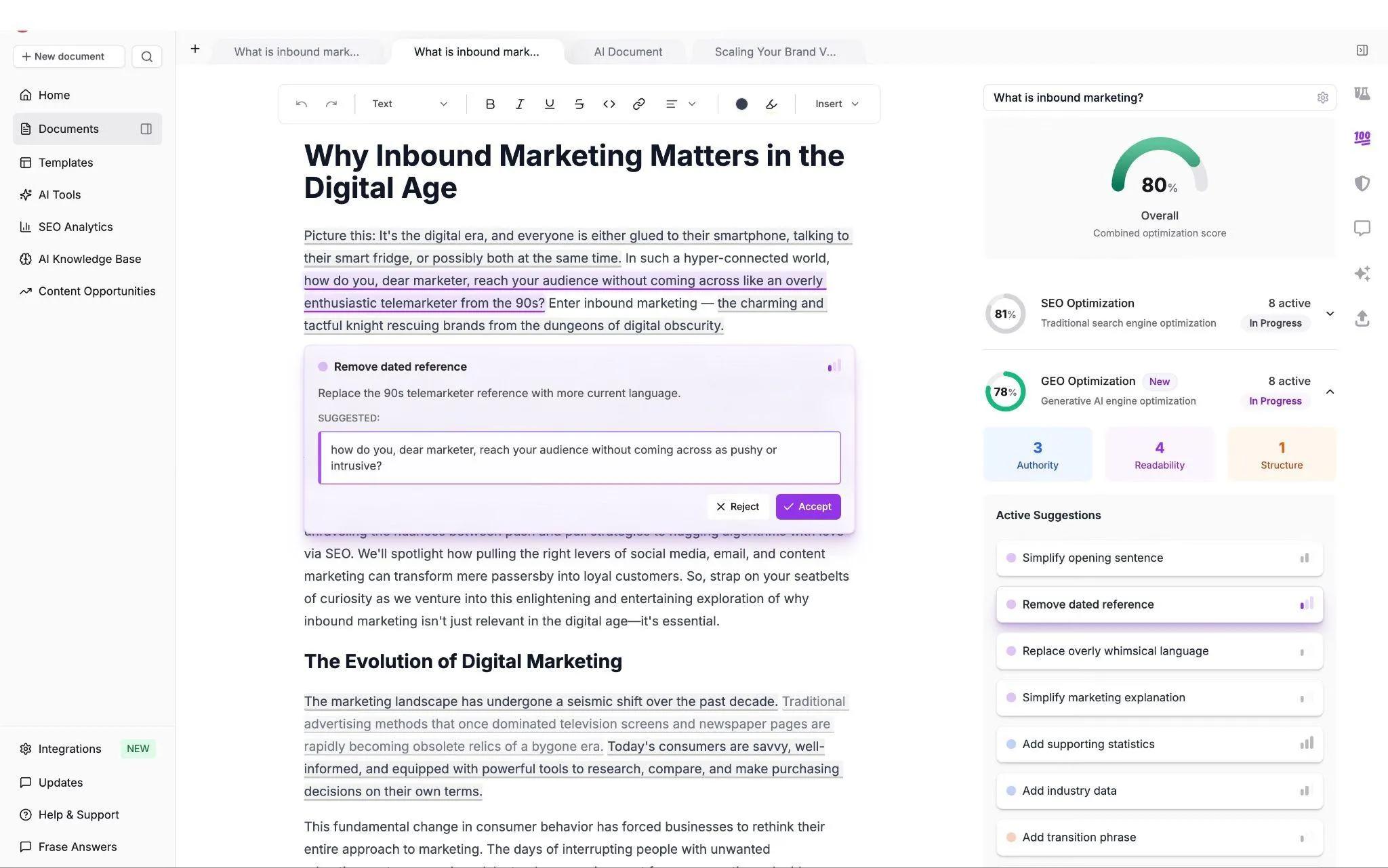
Frase is another all-in-one platform that competes directly with Clearscope and SurferSEO. Frases bundles together SERP research, content briefs, GEO and SEO audits, and AI-assisted content creation and editing. It’s essentially an “everything platform” for content creation, auditing, and performance monitoring.
That said, while its vast feature set is impressive, the platform has a lot going on. The UI is polished enough, but quite cluttered, and there is a lot of information to take in. It does a bit of everything, but I don’t think it’s the best at any one particular thing.
It does have an AI writing editor, much like SurferSEO and Clearscope, with suggestions for keyword density, SEO audits somewhat similar to Ahrefs (though not as deep), and prompt visibility tracking like Peec or Profound.
It’s a good start if you need the basics, but larger brands will likely want something or a dedicated tool for each part of the content audit process.
Pricing: Starter $49/month; Professional $129/month; Scale $299/month. 7-day free trial, no credit card required.
Limitations: AI-generated content requires meaningful human editing before publishing. The interface has had some reported reliability issues, and pricing has changed multiple times.
Best for: Smaller content teams and freelancers who want research, optimization, and AI visibility tracking in one affordable tool.
MarketMuse
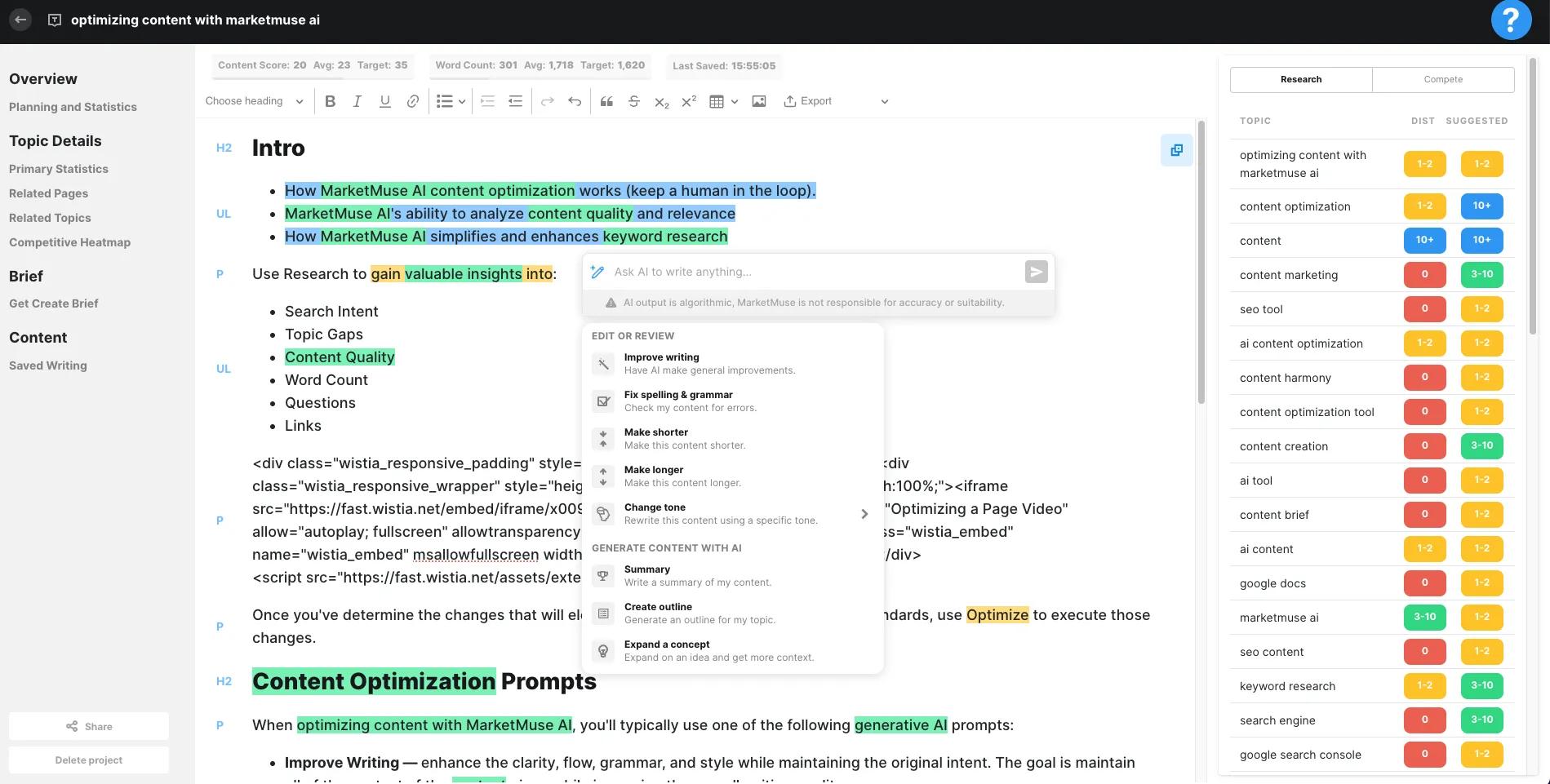
MarketMuse is mostly for reviewing, editing, and optimizing content. The biggest feature is the ability to analyze your content for keyword density. MarketMuse will analyze the top ranking results for your target keyword and then compare the number of related keywords in those articles vs. your article.
There’s also a text editor, integrated with AI to help improve your writing. For instance, you can highlight a sentence and ask AI to rewrite it.
Pricing: Free tier (10 queries/month). No public pricing for paid plans. 14-day free trial available on paid plans. Contact for pricing.
Limitations: Steep learning curve, and the credit system confuses new users.
Best for: Established sites with large content libraries that are trying to build and defend topical authority over time.
A Simple Framework For Prioritizing What to Fix
Getting audit data is straightforward. Deciding what to do with it is where most people get stuck. As Andy Crestodina, Co-Founder of Orbit Media Studios, puts it bluntly:
"It's the 80/20 rule of content marketing: 80% of results come from 20% of your content. This is true for every website and for every content audit I've ever done."
The goal is to prioritize your top content (that 20%) before its performance suffers and competitors beat you out. Your top content might be posts that generate a lot of traffic, or they could be low traffic, but high-intent (pages that generate the most inbound conversions).
Here's a lightweight approach to generating a Content Health Score for each piece of content. Score each piece across three dimensions, rated Low, Medium, or High:
Pages scoring Low across all three dimensions are candidates for removal or consolidation. Keeping them wastes crawl budget and dilutes your site's overall quality signals. Pages scoring Low on one or two dimensions are targeted update candidates, not deletion candidates.
✅ Example: Imagine a post on "project management templates" that used to rank at position 3 and has slipped to position 21, scores Medium on content quality (solid structure but missing current tool comparisons), and scores Low on AI visibility. That's a Low-Medium-Low profile. The page isn't the problem. The execution is. Refresh the examples, update the data, tighten the answer-first formatting that AI engines prefer, and republish.
Frequently Asked Questions
What is the best free content audit tool?
It depends on which part of the audit process you need.
For a technical crawls, Screaming Frog's free version handles up to 500 URLs. For SEO performance data, Google Search Console and GA4 together are free and give you first-party data. For AI search visibility, GEO Audit Tool is a free tool that evaluates your AI readiness along with actionable insights.
How often should you run a content audit?
You should run content audits continuously. Most of the tools on this list have some form of automation to run audits automatically every week or month. I’d suggest doing a more thorough review at least twice per year or quarterly.
What is the difference between a content audit and a technical SEO audit?
A technical SEO audit focuses on the infrastructure layer: crawlability, indexation, site speed, Core Web Vitals, and schema markup.
A content audit focuses on the substance layer: whether your pages are topically deep enough, sufficiently fresh, aligned with current search intent, and visible in both traditional and AI-powered search results.
The two are complementary and most effective together.
How long does a content audit take?
A small site with 50 to 100 posts might take a few hours using GSC, Screaming Frog, and a content quality tool. A mid-size blog with 300 to 500 posts is realistically a one-to-two-week project when done thoroughly. Enterprise sites with thousands of URLs typically require dedicated tooling, multiple team members, and a phased approach executed over several weeks.
What should I do with low-performing content?
Low-performing content generally falls into one of three buckets.
- If the page targets the right intent but has thin writing, outdated information, or missing topics, it's a rewrite or refresh candidate.
- If the same topic is covered better by two or three other pages on your site, consolidation is the answer: redirect the weaker pages to the strongest one and merge the best content.
- If a page is both low-traffic and low-quality with no strategic value, removing and redirecting it can actually improve your site's overall quality signals.