How To Build A Content Marketing Budget That Gets Approved
Most content budgets fail before they reach leadership. Learn how to tie every dollar to a goal and build a plan your execs will actually approve.
A content marketing budget isn't really a single number. It's a plan that ties spending on writers, tools, and promotion back to goals your leadership team already cares about.
Get that plan right and the budget conversation gets a lot easier. Get it wrong, and content becomes the first line item cut when spending tightens.
This guide covers what belongs in a content marketing budget and how much teams at different stages typically spend. It also walks through how to build, pitch, and track a budget that holds up over a full year.
TL;DR
- A content marketing budget covers four things: people, production, tools, and promotion.
- Marketing budgets averaged 7.8% of company revenue in 2026, per Gartner's 2026 CMO Spend Survey. Content marketing is one of the top five areas marketers plan to grow spend in this year.
- Build 2 to 3 budget scenarios instead of one fixed number, and tie every line item to a specific goal.
- Track ROI on a regular cadence so next year's budget starts with evidence instead of guesswork.
What's Actually In A Content Marketing Budget?
Most people think of a content marketing budget as "how much do blog posts cost." That's one piece of it, but far from the whole picture.
A complete budget covers four categories:
- People
- Production
- Tools
- Promotion
Leave one out and the budget runs short partway through the year, usually right when a project needs it most.
People costs
This is usually the largest line item. It includes any mix of in-house writers and editors, freelancers, and agency retainers.
Which mix makes sense depends on team maturity. Earlier-stage teams tend to lean on freelance and agency support because they don't yet have the volume to justify a full-time hire. A single freelance writer producing two or three posts a month is a reasonable starting point for a team without dedicated content headcount.
More mature teams shift budget toward specialized in-house roles once content output is consistent. That might mean an SEO strategist who owns keyword research and internal linking, or a dedicated editor who manages a roster of freelancers.
Agencies still have a place at this stage too. They're often the right fit for larger projects, like a pillar page or an original research report, that need more hands than an in-house team can spare.
Production costs
Production costs cover everything that goes into a finished piece. That includes research time, original data or surveys, design, photography, and video. A simple blog post costs far less to produce than a data-backed pillar page with custom graphics. That gap deserves its own line.
80.5% of marketers now use AI to help with content creation, per HubSpot's 2026 State of Marketing report. That has compressed the cost of a "good enough" first draft.

It has not compressed the cost of the parts that make content stand out. Original research, expert review, and editing still take real time from real people. Skipping those steps usually shows up in weaker rankings and lower engagement.
Software and tools
This bucket includes SEO research tools, content analytics platforms, project management software, and publishing tools that move a finished draft into a CMS. Individual subscriptions look small on their own: an SEO tool here, an analytics dashboard there. Run four or five of them at once, though, and the total adds up fast.
For a breakdown of what's worth paying for at each stage, see this guide to blogging tools and, for agencies specifically, this list of marketing agency tools.
It helps to review this line item annually. Tools that made sense for a two-person team often get replaced or dropped as a content program scales. Overlapping subscriptions are a common, avoidable leak in an otherwise well-planned budget.
Here’s a useful exercise before setting this line item. List every tool currently in use, what it costs, and who uses it each month. Anything with low usage relative to cost is a candidate to cut or consolidate before adding anything new.
Promotion and distribution
Content that isn't promoted rarely earns back what it cost to produce. A promotion budget covers paid social, content amplification, and retargeting aimed at getting a piece of content in front of the right audience. That's separate from any budget spent promoting the product itself.
Teams that skip this line often end up with strong content and flat traffic. Publishing is the finish line for the writing process. Reaching readers is closer to the starting line.
Two costs get missed most often when teams build their first budget. The first is internal time spent managing and reviewing content. That's real hours, even though it rarely gets its own line item.
The second is ongoing maintenance. Refreshing outdated posts and fixing technical SEO issues is a recurring cost, separate from the one-time cost of producing something new.
How Much Should You Budget For Content Marketing?
There's no single right number, but there are useful ranges to benchmark against.
Two ways to think about it:
- As a share of revenue
- As a flat monthly range tied to team size or stage
Budget as a share of revenue
Marketing budgets overall averaged 7.8% of company revenue in 2026, up slightly from 7.7% the year before, according to Gartner's 2026 CMO Spend Survey. Content marketing is typically one slice of that broader marketing budget.
Content is also a growth priority within that budget. 36.9% of marketers plan to increase their investment in content marketing in 2026, per HubSpot's 2026 State of Marketing report. That puts it among the top five areas for planned budget growth this year, alongside AI chatbots, paid social, and video marketing.
Note: CMOs now allocate an average of 15.3% of their marketing budget to AI tools and capabilities. That share climbs past 21% among the most AI-mature organizations. Some of that AI spend overlaps directly with content production and content tooling, so account for it inside your content budget.
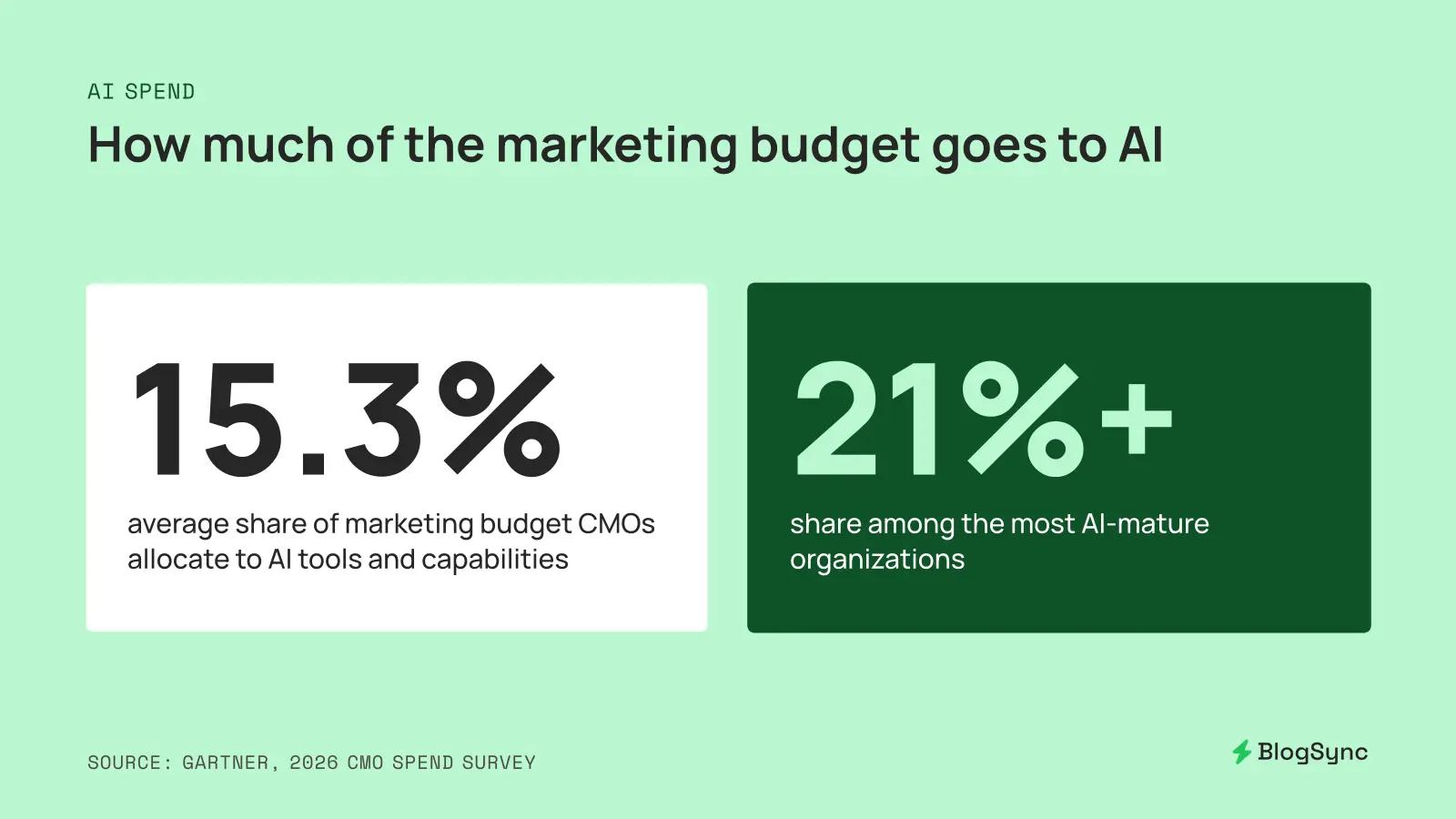
Source: Gartner, 2026 CMO Spend Survey
Budget by team stage
These ranges reflect what different-stage teams commonly spend on content marketing each month, based on what that spend typically buys.
Stage | Monthly range | What it usually covers |
|---|---|---|
Solo or founder-led | Time plus $1,000 to $2,000 | A few posts a month, light design help, a small paid promotion budget |
Small business | $4,000 to $8,000 | One in-house writer or a light agency retainer, plus basic SEO and analytics tools |
Growth stage | $10,000 to $20,000 | A small in-house team or agency partnership, a content manager, and larger monthly projects |
Enterprise | $30,000 and up | A full content team, specialist support, and a meaningful paid promotion budget |
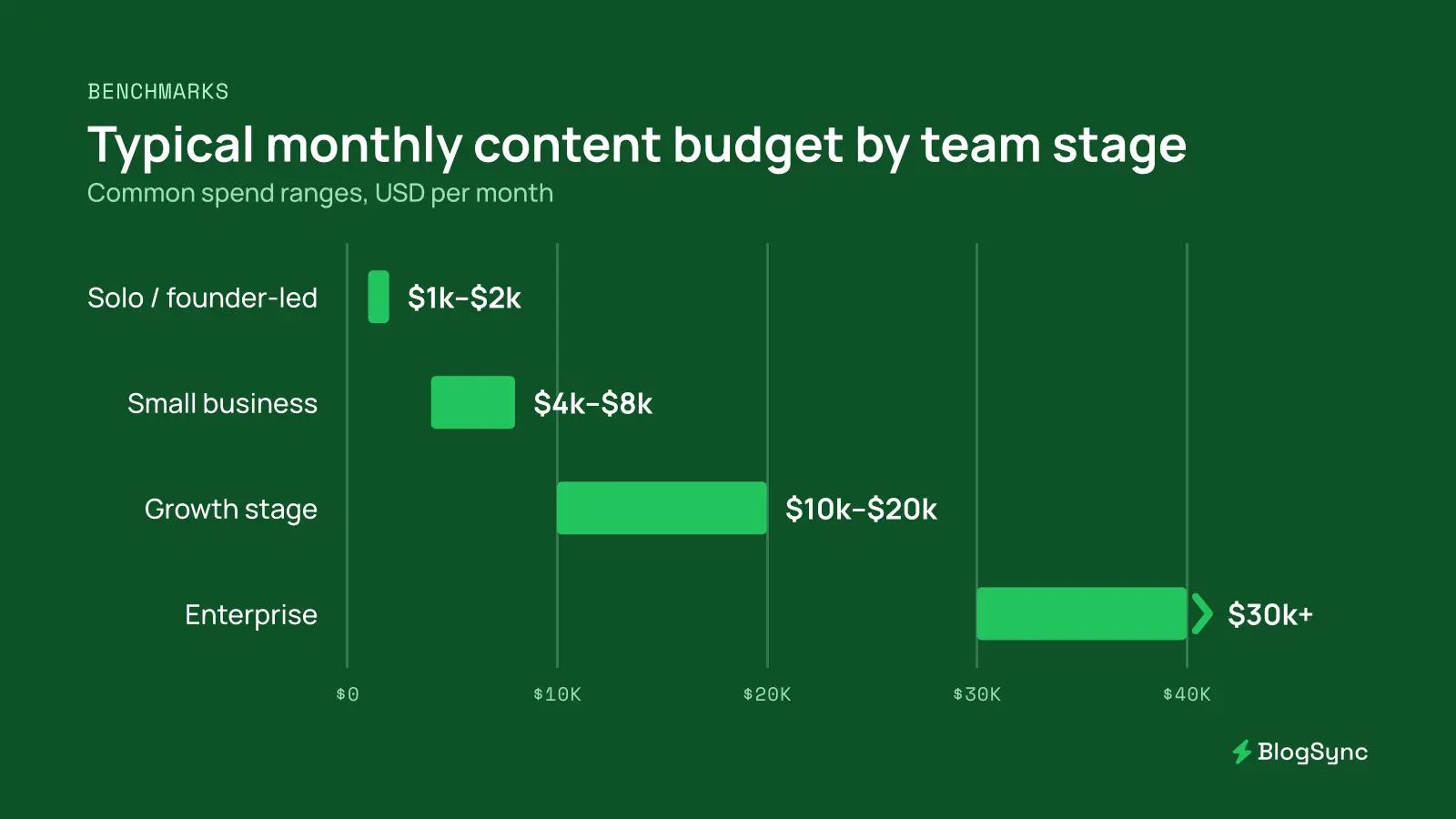
Treat these as a starting point. Spend varies by industry and by how competitive your topics are to rank for. A crowded B2B SaaS category typically demands more investment per piece than a niche with less content already published.
A growth-stage team at the middle of that range might split a $15,000 monthly budget like this:
- $6,000 to $8,000 for a mix of in-house and freelance writing
- $2,000 to $3,000 for a part-time or fractional content manager
- $1,500 for tools
- The remainder for promotion and a larger monthly project, like an original research piece
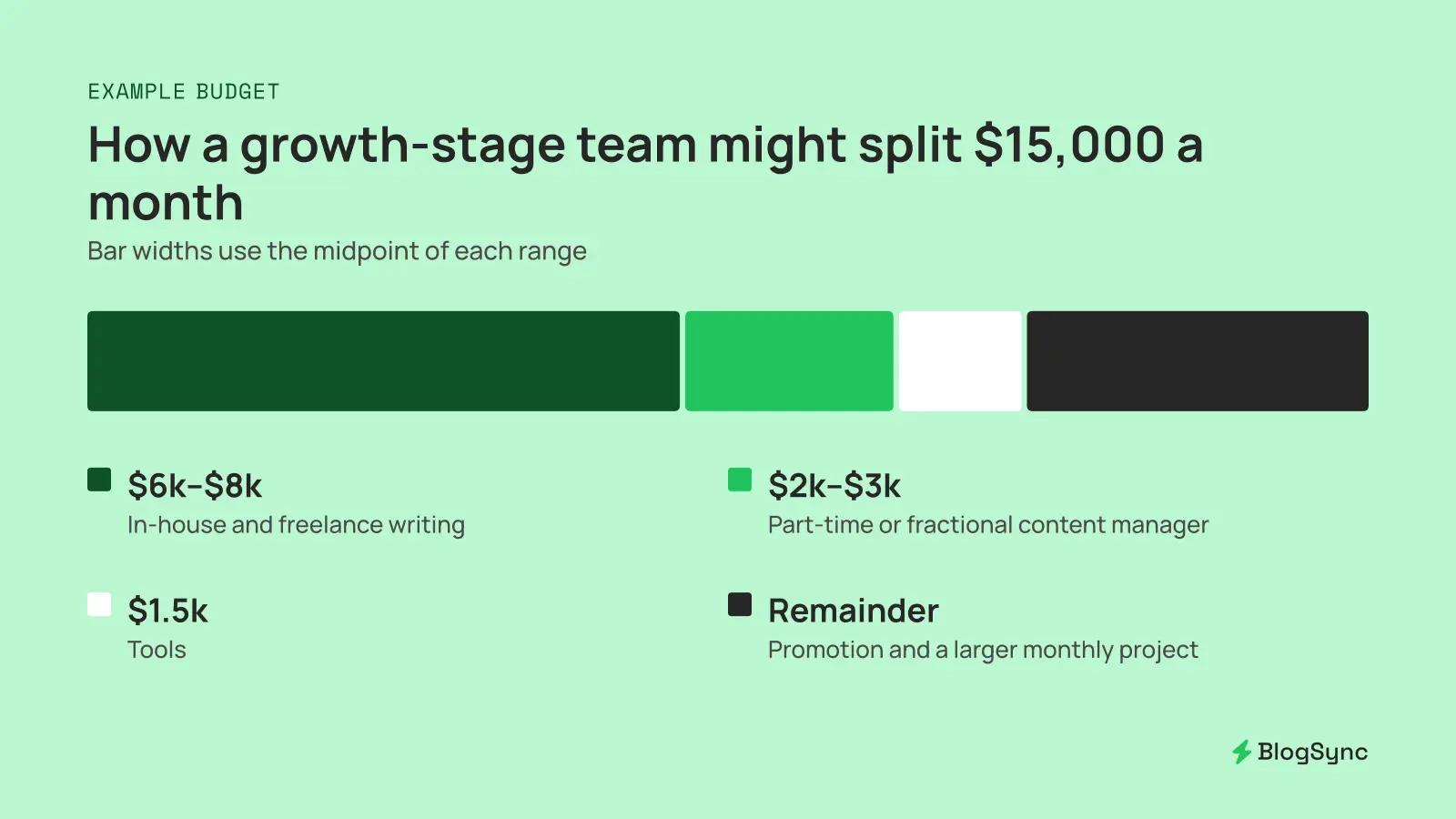
The exact split shifts based on whether the team already owns strong tooling or needs to invest in it first.
Cost by content type
A general blog post typically costs less than a research-backed piece with original data and custom graphics. A short video costs less to produce than a longer one with professional editing. Interactive content, like a calculator or a custom data visualization, tends to carry the highest per-asset cost because of the development time involved.
Rather than budgeting a flat per-post number, plan by content type. Set aside more for the handful of pieces meant to be comprehensive and link-worthy, and less for the higher-volume, lower-lift content that supports them week to week.
A reasonable split for a mid-size team: 2 to 3 flagship pieces a quarter get the bulk of the research and design budget. Faster, lower-cost supporting posts fill the rest of the calendar and link back to them.
How To Build And Pitch Your Content Marketing Budget
Building the budget and pitching it to leadership work best as one continuous process. Do the groundwork early, and the pitch mostly writes itself by the time you present it.
Start with goals, not a number
Before assigning any dollar figure, get clear on what content is supposed to accomplish this year. Tie that directly to a marketing or company goal, like growing organic traffic in a specific product segment or supporting a set of upcoming launches.
Skipping this step is the most common reason budgets get rejected. A number with no goal behind it reads as an ask for its own sake, and leadership has no way to evaluate whether it's reasonable.
A useful habit is that for every dollar figure in the draft budget, write one sentence naming the specific goal it supports. If that sentence is hard to write, the line item probably needs more thought before it goes in front of leadership.
Audit what you're already spending
Before requesting new spend, document what you're currently spending and what it's producing. This gives you a baseline instead of a guess, and it shows leadership you're already managing the existing budget responsibly.
Include current investments across every category from the previous section (people, production, tools, and promotion). Flag anything underperforming so it's clear you're proposing a plan, and not simply asking for more of the same.
Build multiple scenarios
Instead of pitching one fixed number, build 2 to 3 scenarios. This could include a base case, a goal case, and a stretch case. Show what each level of investment would realistically produce in terms of output and expected results.
This makes the conversation easier for leadership. Choosing between a base and a stretch case takes less mental energy than approving or rejecting a single ask outright. It also gives the room something concrete to react to.
A base case for a growth-stage team might hold spend flat and maintain current output. A goal case might add a part-time content manager and increase publishing volume by 50%. A stretch case might add a video budget on top of that and fund one major research report for the year.
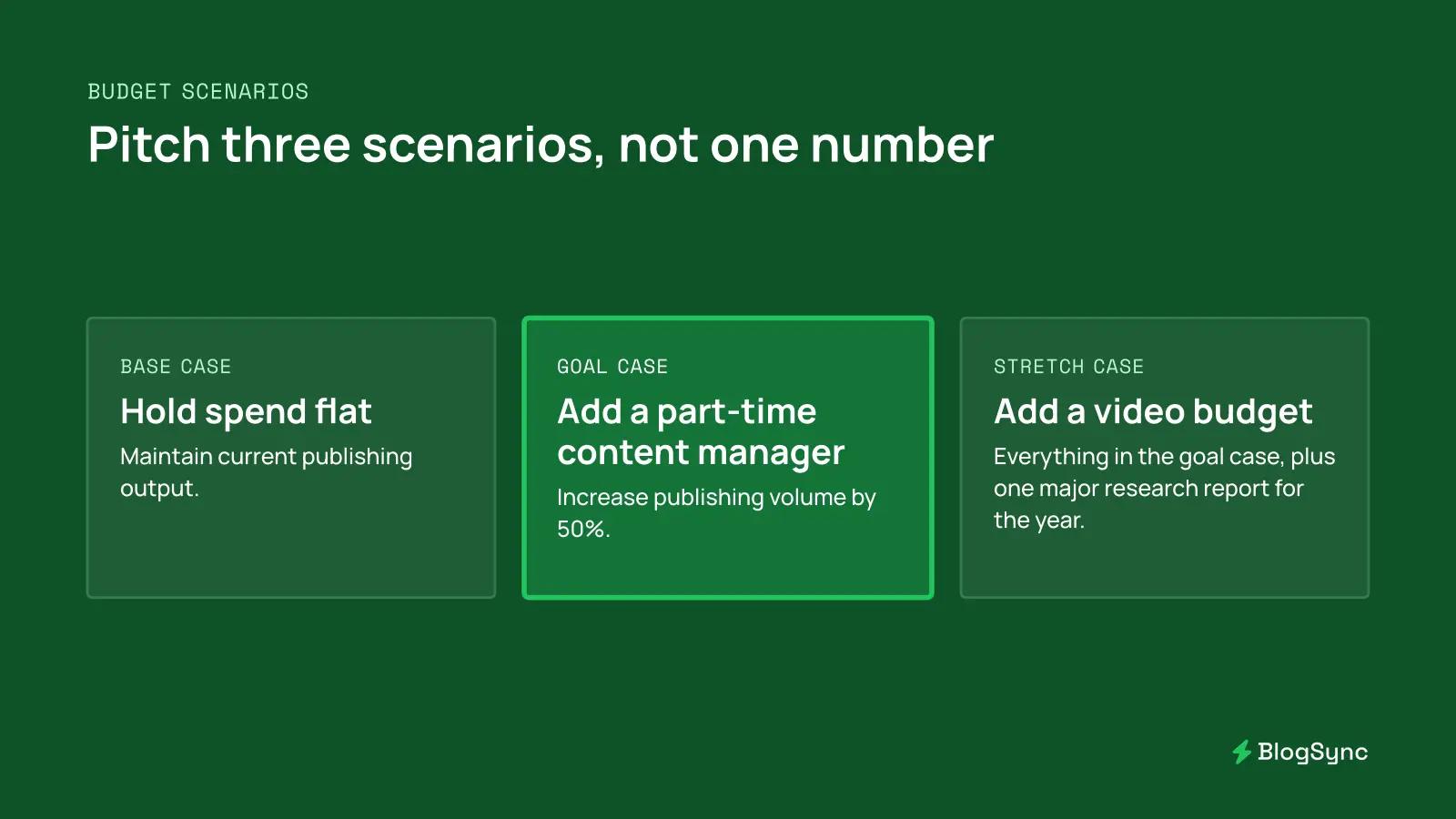
Each scenario should come with a rough estimate of the traffic, leads, or pipeline it's likely to produce. That way leadership can weigh the tradeoff in business terms.
Present the case clearly
Open with why content matters to your specific company. Leadership generally doesn't need a case for content marketing as an industry practice; they need to see how it connects to this year's revenue and growth targets.
Then walk through how each budget line ties back to a goal named earlier in the pitch. Build in real time for questions after the presentation too. A good rule of thumb is to split your time roughly evenly between presenting and answering questions.
Handle a budget cut without losing ground
If leadership wants to trim the budget, lead with your ROI data instead of a defense of content marketing as a discipline. Show what's working, then propose which scenario you'd fall back to and what output that would realistically produce at the lower spend level.
Timing matters here too. Most budget cycles start with planning conversations in Q4. The goal alignment and stakeholder buy-in described above should happen well before the formal ask, ideally weeks ahead.
How To Track ROI And Adjust Your Budget Over Time
A budget that isn't tracked against results is just a guess that gets repeated every year. Tracking ROI is what turns next year's budget conversation into an evidence-based one instead of a rerun of this year's.
Pick metrics tied to outcomes
Raw traffic and pageviews are easy to report but don't tell you whether content is doing its job. Metrics tied to business outcomes, like organic conversions, pipeline influenced, and ranking movement on revenue-driving keywords, are what justify a budget to someone outside the content team.
Different goals call for different metrics. Match the metric to what that piece of content was funded to do.
Top-of-funnel content is best measured by organic traffic growth and ranking position on target keywords. Middle-of-funnel content is better measured by email signups, gated asset downloads, or time spent on page. Bottom-of-funnel content, like comparison pages or case studies, should be measured against conversions, demo requests, or a direct assist in closed deals.
Note: ROI varies meaningfully by content format. Short-form video was cited by 48.6% of marketers as delivering the biggest ROI this year, per HubSpot's 2026 State of Marketing report, compared with 22.3% for blog posts.
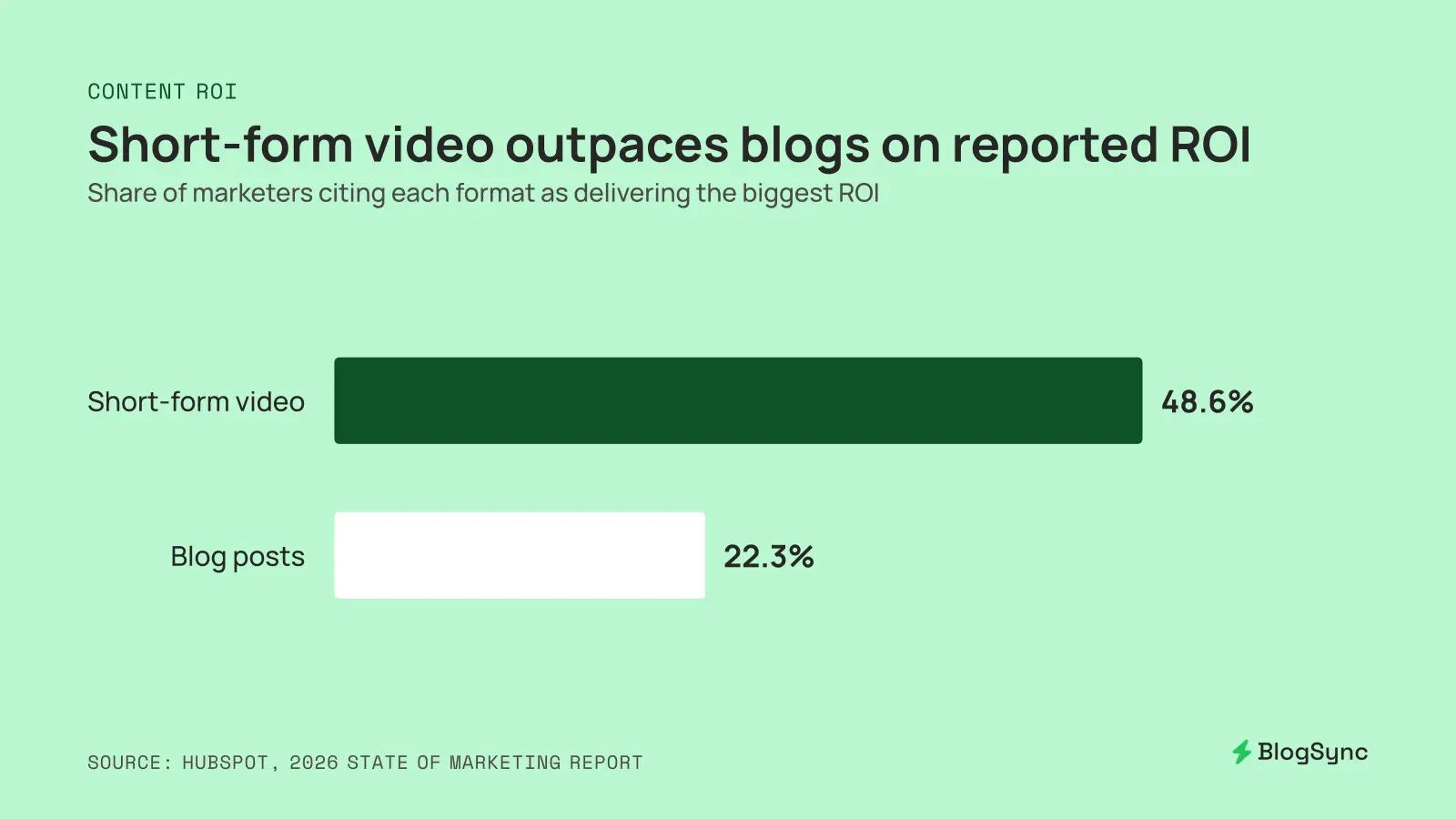
Source: HubSpot, 2026 State of Marketing report
That doesn't mean blog content is a poor use of budget. It's a useful data point when setting expectations for what different content types can realistically deliver, especially the first time a stretch scenario includes video.
Build a simple reporting cadence
A monthly or quarterly review, even a lightweight one, is enough to tie performance back to the budget scenarios built earlier. Note what's working, what isn't, and why. For a deeper framework on which content metrics tie back to revenue, see this guide to content marketing reporting.
This matters more than it sounds like it would. Without a written record, the reasoning behind last year's decisions gets lost, and each budget cycle starts closer to zero than it needs to.
A simple version of this report covers what was spent, what it produced, and what changed from the prior period. Keeping that history in one place, even a basic spreadsheet, makes the next budget pitch faster to put together and easier to defend.
Know when to keep investing versus when to cut
New content usually needs time to rank and convert. Don't pull the plug on a reasonable piece after just a few weeks; set a review window, 60 to 90 days is common (SEO can take even longer if you are just starting out), before judging a piece's performance.
After that window, be honest about what isn't working. Redirecting budget away from underperforming content toward formats and topics proven to convert is part of managing the budget well.
A piece that's ranking on page two after 90 days but showing steady month-over-month movement is usually worth another update cycle. A piece with flat rankings and no movement at all after that same window is a better candidate to retire or fold into a stronger, related page.
Where Your Publishing Workflow Fits Into The Budget
One cost that rarely gets its own line item is the operational drag of getting finished content out of a document and onto a live page. Every hour a writer or editor spends reformatting a draft or re-uploading images is an hour not spent on research, strategy, or the next piece.
BlogSync publishes directly from Google Docs, Microsoft Word, or Notion into WordPress, HubSpot, Webflow, Sanity, and several other CMS platforms. It skips the manual cleanup that usually happens between a finished draft and a published page.
It also handles image optimization automatically: renaming and compressing images, converting them to web-friendly formats, and generating alt text as part of the publish step. For teams publishing across more than one CMS, the same document can go out to multiple destinations without reformatting it separately for each one.
None of that replaces any of the budget categories covered above. It changes what your existing budget buys.
Hours previously spent on formatting and re-uploading can go toward research, promotion, or simply a few more pieces of content each month. That happens without adding headcount or asking for more budget in next year's pitch.
If publishing overhead has been quietly eating into your content team's time, give BlogSync a try and see how it fits into your current workflow before your next budget cycle.